Category: Africa

There’s nowhere like it on the planet for wildlife, wild lands and rich traditions that endure. Prepare to fall in love.

  • Week 8 – Dar & Morogoro

    Week 8 – Dar & Morogoro

    Day 50 & 51 – a messy night in Dar

    I headed to Dar Es Salaam on the friday night, using the new high speed train. It is awesome. 2 hours of relaxing in comfort, versus the 5 or 6 hour crazy drive with endless police traffic stops, speed limits and slow trucks. The time went pretty quickly as I chatted to a tractor salesman from Dodoma who was sitting next to me.

    I was met at the station by Sumas cousin David, we got into a bajaji (tuk-tuk) and headed the short distance through crazy traffic to her brother Jons’ place in Upanga East. Jons, David, Ole (Maasai) and me headed out about 9pm for some food and drinks.

    We went to the well known downtown bar/club Samaki-samaki after food. I tried to order a round of large whisky & cokes. Somehow it got mixed up with all the noise and the waitress arrived with a 75cl bottle of Jack Daniels and 4 cokes. The night got a bit messy from there on. We ended up in an upmarket club called XII – XIV and got back to Jons’ flat around 5am. I haven’t stayed out that late in a good few years. Great night.

    The next day was mostly napping and recovering.

    Day 52 – Kids arrive!

    Suma and the kids were due to land at Dar Airport by 4pm, so we decided to head to Mbweni JKT to see the plot of land and chat about how to develop it. We got halfway there when Jons’ Mercedes E-class started to overheat (we had sent it to him from the UK a year previously). We couldn’t continue, so we waited while a mechanic came with a computer to diagnose the problem.

    David and me got a bajaji to the airport to find Suma and the kids there waiting for us. It was great to be reunited with my boys after 7 weeks away from them! We headed to Jons’ flat then headed out for some food and a shisha, getting an early night.

    Day 53 – Coco Beach

    Suma went to get her hair done so me and the boys headed to Coco beach. The kids played with car inner tubes in the surf while I sat in the shade. Later that afternoon we headed to Morogoro on the evening train, arriving at Grace’s house around 9.30pm.

    Day 54 to 57 – Hanging out in Morogoro

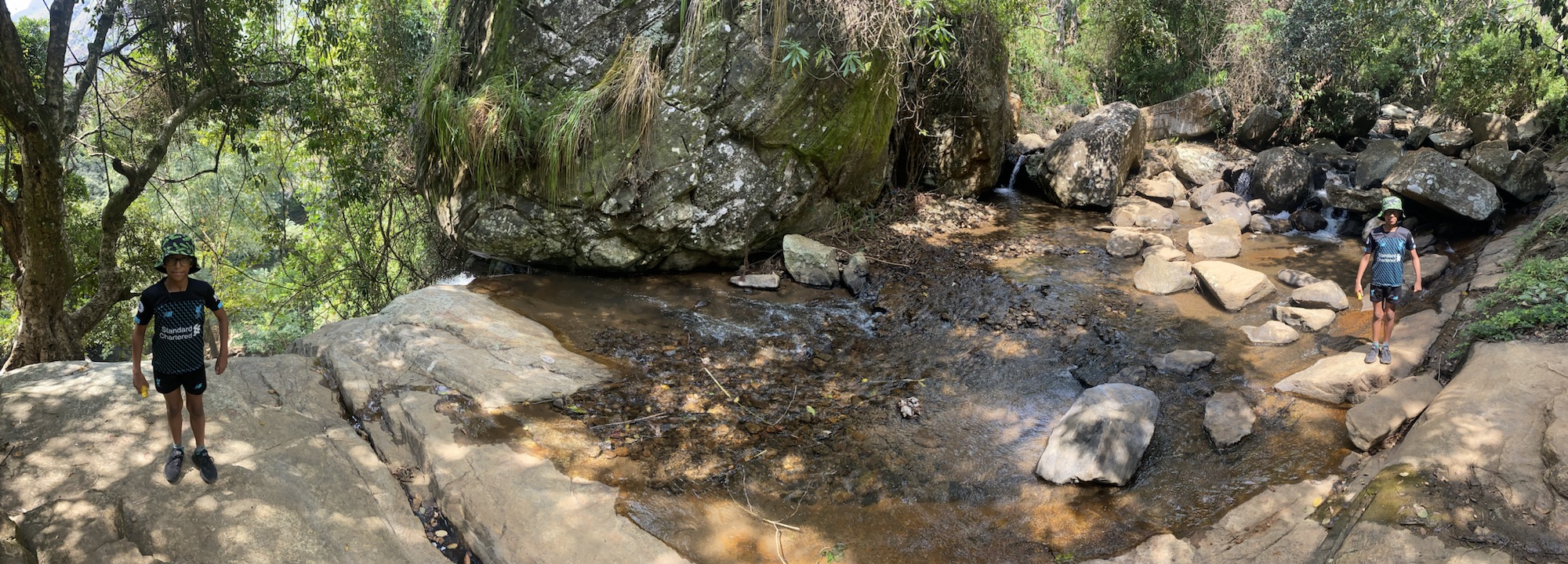
    We spent this time relaxing with Grace, venturing out to town now and again, to the farm, Mzumbe and hiked to a very nice waterfall in the nearby Uluguru hills.

    A nice clean car
    Fun on Coco Beach, Dar Es Salaam
    Waterfall walk, Uluguru Mountains, Morogoro
    Two Reeces!
  • Week 10 – Tanzania Northern Safari Circuit

    Week 10 – Tanzania Northern Safari Circuit

    September 12, 2024 2:00 pm

    Week 10 – Northern Circuit

    • Distance Instructions

    Day 65 – Tarangire National Park

    The next morning we woke early to leave at 9am for a full-day game drive. Due to the dust being kicked up by road improvements on the NP access road, our driver took us on a diversion through Maasai villages: they now live in permanent settlements with access to schools and healthcare.

    The car park at the entry gate was rammed full of safari vehicles, all checking permits to access. The park is very busy, and this was our first taste of just how busy the Tanzanian Northern Safari Circuit is.

    Everything rattled on this car

    Our drive was great; the park has a great mix of dense short woodland, semi-open scrub and pockets of grassland. The Tarangire river is also very pretty, and there are some lovely riverside drives. The river is too low for crocodiles and hippo.

    We were lucky enough to see two Cheetah relaxing on a rock outcrop. They also walked quite close to our vehicle. This experience we shared with maybe 50+ other safari vehicles. You join a queue of vehicles and inch forward, so everyone gets a chance to view the game. A handful of idiot drivers try to bypass the queue and cause huge traffic jams, completely blocking the road in both directions. All to please their clients, who are somehow more important than everybody else.

    We stopped by one of the expensive lodges for a quick toilet break. It is built on a bluff overlooking the Tarangire River, so we had a look from their terrace. The view was amazing, but for $765 USD per night for 4 of us (Josh is 13 so charged as an adult) it was way beyond our price point. If you have the funds, it would be pretty amazing there.

    Swanky lodge for $765 USD per night for 4 of us…

    After a fantastic game drive, and we had finally had enough of the rattling noises from the car, we stopped at a cheap restaurant for tea then headed back to camp. Our guide then told us that the Rangers had called him to complain that the ranger who had accompanied us the previous night was upset that we had not paid him. We pointed out that we had paid for everything at the entrance gate, including the ranger fee. The guide said that the rangers expect a Tsh 20K tip (around £6). If this ‘tip’ was not paid, then the guide would not be receiving any more rangers for future night drives. Whether this was a ruse to increase his tip Im not sure, but we left the issue to be resolved between the guide, the middleman and the ranger. We gave the guide a tip regardless, as is customary in all countries outside the UK.

    Although the camp was basic, and the safari vehicle not the best, we thoroughly enjoyed every minute. Also, it felt like we were supporting the local community a little; everything we paid (apart for park entry fees) went to Maasai-owned businesses. Expensive high-end package tours, amazing as they are, give little back to the local communities whose ancestral lands they operate in. Very high park entry fees go straight into TANAPA’s accounts. TANAPA reinvest the bare minimum into the park facilities, (which are shite) so its safe to assume little goes back into the local communities. There is abject poverty in the villages bordering the parks.

    On returning to camp we found it was overrun with a huge party of Kenyan overlanders. One or two were happy to chat, but most were busying themselves with camp chores. One had pitched his small ground tent 2ft from our car, so it was like a European campsite in summer.

    Day 66 – Lake Natron

    View of the Rift Valley Escarpment en route to Lake Natron
    Ol Doinyo Lengai – stunning scenery reminiscent of Namibia
    View from ‘World View Campsite’, also known as ‘F**k me what a view Campsite’
    Ol Doinyo Lengai

    Next morning we woke up to find the campsite empty again – the Kenyans had woken up very early in order to reach Iringa that day (a very long drive!).

    I decided against going to Ngorongoro due to the huge cost of visiting there, but we still wanted to visit the Serengeti. The obvious route takes you up to the north gate via Lake Natron. Our aim was to find a camp near the lake. The drive along the gravel road was stunning, with the scenery wide open, dry, and desolate, like parts of Namibia. You can see the wall of the Rift Valley for much of the drive. We paid some money to the Maasai at the entry gate (this is a Conservation area, the entry fees going to the local council, so stays within the community). World View Campsite popped up on iOverlander, and the name sounded attractive; we like nice views. We could see it up on a bluff overlooking the wide valley, which is dominated by the majestic and perfect volcano ‘Ol Doinyo Lengai’.

    We did a walk to a nearby waterfall. The trail starts quite easy, but the last few hundred metres involve wading and scrambling. The waterfall itself is very nice, the last stretch you pass through a narrow slot canyon. Its very nice and worthwhile if you have a couple of hours to spare. The water isn’t too cold. You have to pay to visit the waterfall, and also take a guide with you. The money stays within the community.

    We decided against staying for another day due to time constraints. There are other excursions you can do in this area, such as: sunrise hike to Lake Natron, or a strenuous hike up the volcano (said to be the most challenging single day hike in East Africa). Maybe leave this for another trip when im a bit fitter – 2 months of sitting on my arse driving across Africa isn’t exactly the sort of training needed before tackling such a hike.

    Day 67 – Northern Serengeti

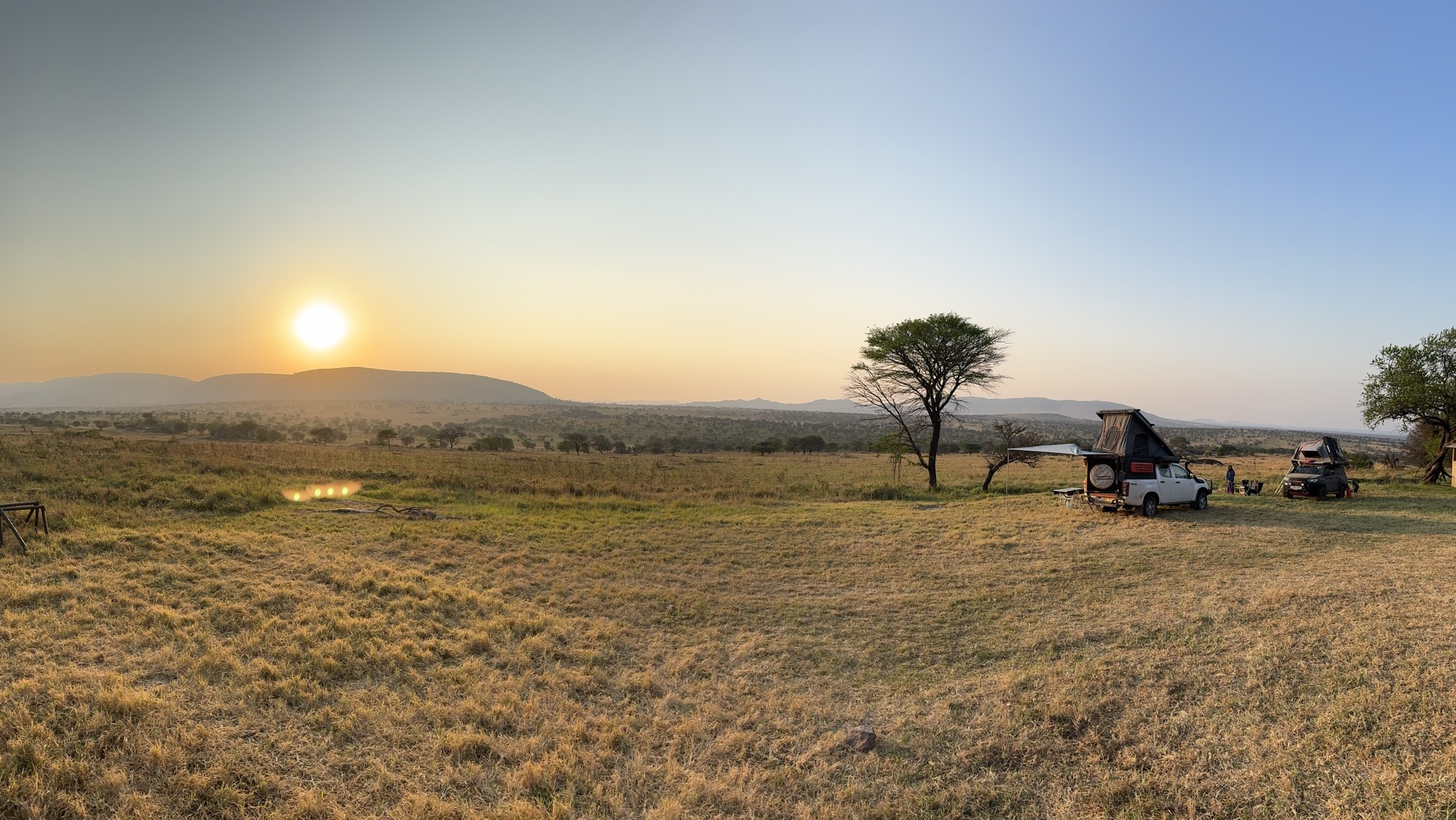
    Leaving fairly early we made our way towards the Northern Serengeti, entering via Klein’s Gate. We paid for 3 days and 3 nights at the public campsites. You can use any of the public camps, they don’t need to be pre-booked. The area surrounding Klein’s gate was being burned, so was not that pretty to look at. We drove the 20+ km to Lobo Camp. Lobo camp is in a great location. It has superb views across a wide valley, and 2 resident Lion prides whose territories meet near the camp. It is a model camp that all other Tanzanian National Park Public campsites should take note of. The toilets & shower block need updating, but they were clean. Tired facilities can easily be overlooked when the location is a spectacular as this; great views and abundant wildlife make this a very special camp.

    The campsite was fairly quiet, there weren’t many other groups. We decided to pitch up on the edge of camp, giving us the best views and also bringing us closer to the wildlife. Having a rooftop tent gives a feeling of safety. When evening came one of the camp staff sold us some firewood, and we sat around the fire drinking and chatting. Camping in such a place and being safe, especially with children, means there are a couple of sensible precautions; 1. Light a fire at night. 2. Keep the kids very close – sit them in the middle of the group, not on the edge. 3. Nobody wanders off.

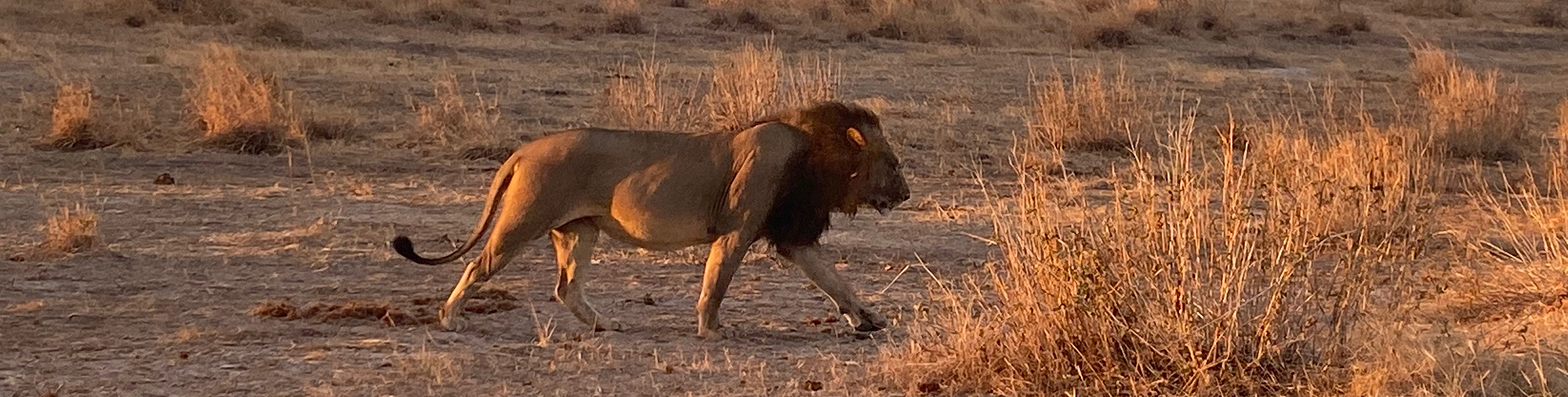
    A pride of lions began roaring soon after it became pitch black. It was quite loud so I estimate about 200m to 300m away. Not long after, the roaring started again, and it was getting louder. Ten minutes later the roaring started again, and it was louder still. I couldn’t see anything using the high powered torch, but the kids decided it was time for bed. They scampered up the ladder pretty sharpish, me and Suma finished our drinks and followed them up soon after. The lions continued to roar through the evening.

    We were aware of something eating grass outside our tent, I popped my head out (definitely not something you can do with a ground tent BTW) and it was a large lone Buffalo grazing peacefully just outside the camp. Going back to sleep, we were woken up by a loud roar outside the tent. Looking out again I saw the same Buffalo charging a lone female lion. The lion retreated and disappeared off across the open grassland. The lion pride kept roaring, off in the direction the female lion had travelled, and we heard noises consistent with lions attacking the Buffalo. Shining the torch across the grassland again, one of the camp staff asked us to stop using the torch. We switched it off and tried to get back to sleep, without too much success. I was concerned at the damage a 1 ton Buffalo running through camp could cause to my camp table, camp chairs and car. There were some people in ground tents pitched in the middle of the campsite too, and they wouldn’t fare too well either against a rampaging buffalo.

    Day 68 – Northern Serengeti

    Next morning the grassland was empty – no sign of Lions or Buffalo, so we assumed the Buffalo had successfully fought them off. The camp staff explained why shining a torch during a hunt was a bad idea: when in trouble, the buffalo would head towards a source of light thinking it would be heading to safety. They had an incident where this had happened, and a buffalo being chased by a pride of lions had caused some chaos in camp.

    We got chatting to a friendly Italian newlywed couple, who had been in one of the ground tents. Their guide, Sam, said we could follow them on a game drive way north-east to the Mara river, where we would hopefully see the Great Migration of the Wildebeest. The drive was quite long, through lovely scenery. At this time of year (early August) the herds are in the Northern Serengeti where the grass is nicer (the southern grasslands have long dried up and being eaten by now). They form large groups and band together to cross the Mara river. En route to the river we saw many thousands of Wildebeest and Zebra grazing alongside each other in widely-spaced enormous herds.

    Sam was able to locate a crossing point where there was a group of Wildebeest nervously walking around and grazing – a potential chance to see them cross the crocodile-infested Mara river.

    In my best whispering Sir David voice:

    “And here we see, lined up along the banks of the Mara River, in remote Northern Tanzania, we see the worlds largest herd of that majestic creature; the Toyota Land Cruiser.”

    There were well over a hundred, far outnumbering the small group of Wildebeest nervously pacing the banks. They were all lined up 100m back from the river, so as not to disturb the crossing. When a crossing occurs, all the Land Cruisers sprint towards the river so as to get the best view of the Wildebeest.

    We stayed for about 40 minutes, the idea of a sprint to the river not really floating my boat. Besides, it was a bit hot for us to sit in the car with the engine and AC switched off. I dont think Im cut out for a career in wildlife photography! We had a slow drive back, following partly the course of the river. There were some very well-fed crocodiles sunning themselves on the banks.

    We had a pleasant evening sat by the campfire, and again there were Lions nearby. We heard plenty during the night, but there was no action like the first night. It rained from about 2am onwards, so I had to unroll and deploy the rain flysheet. I was able to do this without leaving the tent, it was all done through the roof hatch. A very nice feature of the Roofnest!

    Day 69 – Central Serengeti

    We had a fantastic 2 nights at Lobo, so now it was time to head towards Seronera in the Central region of the Serengeti. We had a previous recommendation to stay at Pimby camp, but we spoke to Sam and he was headed to Nyani Public Camp. We headed there with them. We had some great game drives, some with Sam, some on our own. We had several Lion & Hyena sightings. Loads of stunning scenery, Koppijes just like out of the Lion king. What an amazing place.

    The Nyani campsite is not great: the toilets are smelly, bins are overflowing with kitchen waste. I saw the fattest Banded Mongoose ever, he was almost too fat to climb up into the filthy bin. The campsite is truly minging. If I had paid $10 USD to stay there it would be OK. But here in the Serengeti you pay big money, and it is not good value. The amount of money that TANAPA receive, they really should reinvest some in the public campsites. Lots of people use them. Not just independent overland travellers like us; there are lots of budget tour groups of various sizes who rely on these campsites to give their customers a unique safari experience, but without the hefty price-tag of the luxury high-end lodges. They are mostly Europeans and US tourists, and we don’t like filthy facilities, at any price point.

    It was at this point we (or rather, I) decided that despite the massive cost of visiting Ngorongoro, since we were here, we might as well go and do it. Its easier to live with a £600 hole in the wallet than the regret of not having done something that is widely known to be pretty awesome. So the plan was changed and we decided to tag along with Sam for another day.

    Day 70 – Drive to Ngorongoro

    We did a short game drive in the morning then drove to Ngorongoro. I had a bad stomach and had to stop for a most unpleasant shit behind a large bush on the main dirt highway. Predator risk aside, the road is very busy so everything is coated in a fine powdery dust. The bush gave little cover and the ground was covered in horrible spiky plants. I wish I’d known that 2 miles further down the road was the park exit/entrance gate with great facilities.

    We arrived at the public camp at the top of the crater and found a pitch with some degree of wind shelter. We arranged the camp so that we could sit on the leeward side of the car and get out of the wind, with the ammo crates under the car as an additional wind-shield. The campsite was OK, but again, not worth the price-tag. We had a very smoky camp fire which we shared with Sam and his Italian guests. The morning we woke to find ourselves in the clouds, everything soaking wet. We quickly packed up and followed Sam down into the crater.

    The drive around Ngorongoro Crater, despite being vastly over-priced, was beautiful. Clouds spill over the craters’ edge like a waterfall. We saw some lions and, after much trying, was finally able to see a Rhino in the wild. There is plenty of wildlife here and it is fantastic. Im glad we went, but I wont be visiting there again; the price is far too high.

    Day 70 – Mama Salma’s place in Marangu

    Since we had gone to Ngorongoro, it would add an extra day of driving to our original route which was intended to take us to Lake Victoria, then across to Kigoma and down Lake Tanganyika, Katavi, Mbeya, Iringa and back up to Morogoro. We had a look at the map in order to evaluate the options. This was a big distance to cover in only 2 weeks; should we burn through a load of miles and have to rush things? Or should we take a leisurely drive back towards the coast, exploring places that we had rushed past in our haste to get to the Northern Safari Circuit? Leisurely cruise seemed to be universally preferred when put to the vote. Lake Victoria can wait for another trip.

    So we headed back towards Moshi, stopping for some amazing food at a shopping centre on the road south towards Tarangire/Manyara. After spending a week eating noodles and snacks, a hearty meal was appreciated. I purchased some Tanzanite earrings for Suma, they were exactly what we were looking for.

    We drove on towards Moshi. Sumas brother Gwmaka had said we should have stopped at his wife’s family home near Moshi when we first passed through Moshi. So we got in touch and they said we could stay there. It took a while to find: it is in Marangu: right up on the side of the lush green lower slopes of Mt Kilimanjaro, just outside the National Park boundary, and it was after dark when we arrived.

    The house caretaker Iddy helped us settle in and gave us some firewood to make things cosy for us.

  • Week 11 – The Green North of Tanzania

    Week 11 – The Green North of Tanzania

    Day 71 – Marangu

    Iddy took us for a walk to a nearby waterfall, we visited Mama Salma in the afternoon & popped into Moshi for tea and pick up a Tanzanite bracelet.

    Mama Salma’s place

    Day 72 – Leaving Marangu

    We left Marangu, both Suma and me feeling quite ill from probable mild Carbon Monoxide poisoning from the a partially blocked flue on the inside wood fire. There is a road that circles Mount Kilimanjaro, and at Josh’s request we drove it – we were hoping to get a glimpse of Mt Kili. The drive was quite long and a bit dull. It would may be of interest to visitors new to Africa who fly into Arusha, but for us who are accustomed to seeing East African lush forest, it wasn’t so interesting.

    Quite close to Kenyan border, we pull over & discuss the option of crossing over into Kenya and visiting Amboseli, Tsavo E & W then coming back down the coast into Tanzania. The kids weren’t bothered: me and Suma didn’t feel like dealing with border control while being off colour so we pigeon-holed it for a future trip.

    We headed towards Lushoto. We stayed near Mwanga in a nice quiet little lodge. It was very good value for money at 70k Tsh for 2 rooms with evening meal and breakfast. I was still a bit off-colour but, improving after a lie down and a couple of small beers.

    Day 73 – Lushoto

    Avoiding the main tar toad, we drove around the back of the Pare mountains. I let Reece sit on my lap and drive the car for the last 30km of dirt road. He was super happy being allowed to drive. When you ask him what was his most favourite part of the trip, this was it. Josh’s favourite part of the trip was when we reached the tar road and i took control of the car again.

    We then drove up to Paradise Eco Lodge way up in the Usambara mountains near Lushoto. Lack of good signage and a very narrow, steep, rutted & precipitous dirt track meant we had to keep stopping to ask locals if we were on the right route. It is a very nice lodge with amazing views, very high up and only accessible with 4×4. I wouldn’t like to try getting there in the wet season, there are long drops off the edge of the track.

    We stayed in a very nice room instead of camping.

    One of the numerous waterfalls in the Usambara Mountains

    Day 74 – Lushoto

    Usambara information: Its a huge mountainous area jutting out of the flat surrounding plain. There are loads of hills, valleys & mountains going up to about 1800m, with numerous farms, villages and forest reserves covering the whole area. It seems like its own completely separate community, accessed by a 1.5 hour drive up from the plains below. Food grows everywhere, and the people have their own distinct culture and language (Sambara). People here are noticeably shorter and with slightly lighter skin.

    We did a few short walks around the area with the lodge manager as our guide. We walked to a nice viewpoint, finding a Chameleon, followed by a nice waterfall, then finally a short walk up the hill from the lodge to a great viewpoint to watch a lovely sunset.

    The council bollocked our guide near the waterfall as he wasnt an ‘official guide’. The land around the waterfall base had been annexed by the local council as they want to charge people to visit it. The owner of this land, who built the stepped access trail and built viewpoints was understandably none too pleased. He had a small shop selling drinks and snacks, and was furious with the council who were demanding a cut of his takings. The council seem a bit over-zealous in their pursuit of cash, and maybe need to be a bit more sympathetic to the landowners, who have lived there for generations.

    Day 75 – Tanga Coast

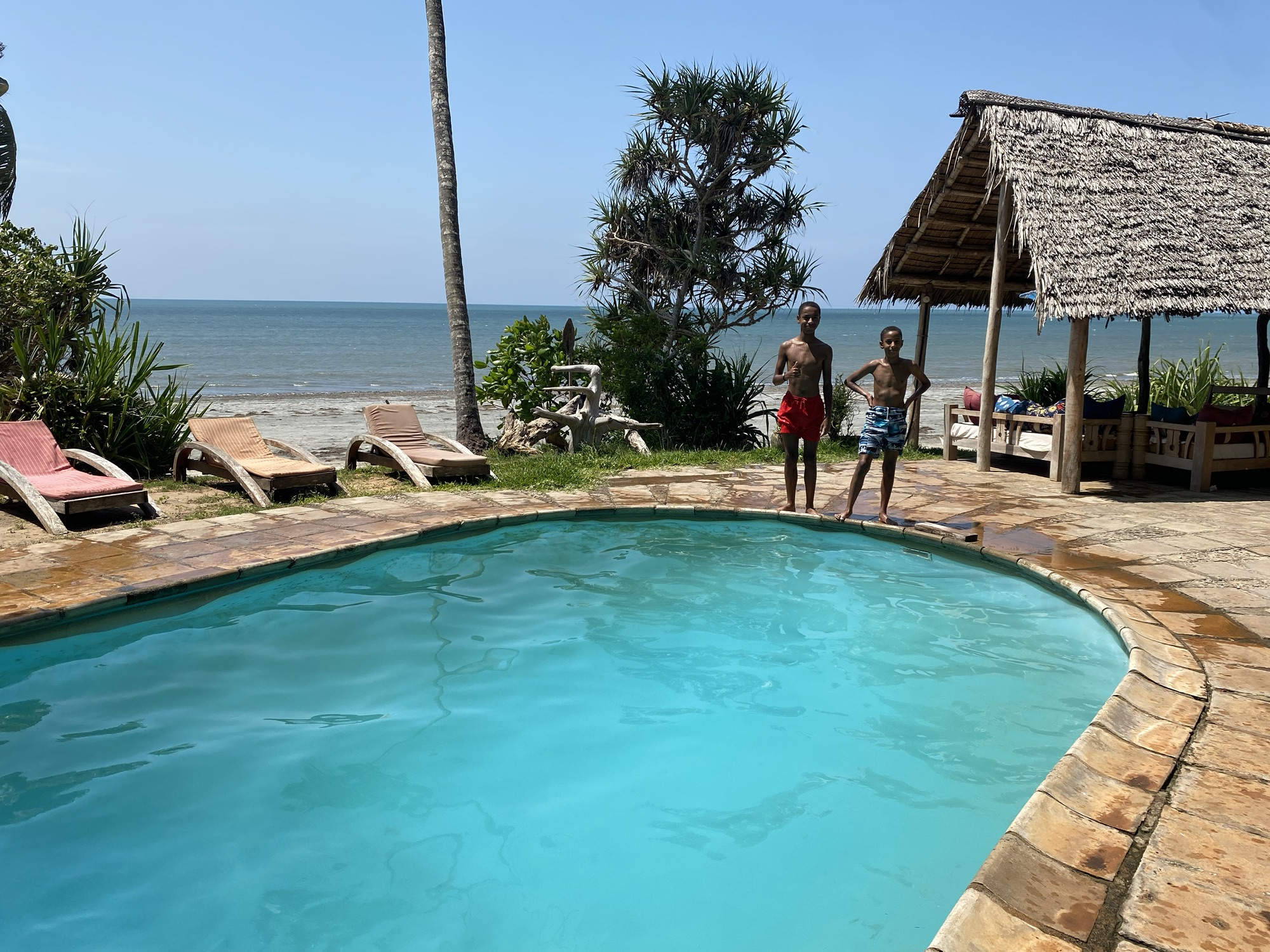
    We left Lushoto and drove towards the coast, heading to find somewhere between Tanga & Pangani. We had plenty of time so we looked in at all the places between Peponi Beach resort and Bahari Pori. All were very nice and had excellent rooms. We were spoilt for choice, all were empty too. We decided to camp at Peponi beach, as they had a pool, a shaded beach-side pitch and a really nice shaded bar/chill area with sea-views.

    Very nice place and only $8 USD pppn to camp.

  • Week 12 – Swahili Coast Tanzania: Pangani

    Week 12 – Swahili Coast Tanzania: Pangani

    Day 76 – Peponi Beach Resort

    The day was spent working on emails & relaxing at Peponi Beach resort. The kids loved the pool. The owner of the Capricorn Cottages next door stopped for a chat with us, and invited us for food and drinks with her husband and some other ex-pats who meet there every friday afternoon.

    We met up with them round 4pm and spent a couple of hours chatting to some interesting people who we hope to see again in future.

    Peponi Beach Resort

    Day 77 – More beaches

    We went to see Sally & Geoffs house, the ex-pats we met next door. They have a very nice place set on an 8 acre beach plot. We had a contact who had 4 acres of beach plot for sale, so we drove down to nearby Bahari Baobab lodge south of Pangani, just south of Ushongo near Beach Crab resort. It was closed but they opened for us and we had a lovely beach safari tent. The resident pack of 6 dogs were a bit excitable and annoying to begin with, getting underfoot all the time. The large one kept nipping me me so I gave him a slap. During the night the 2 smallest dogs insisted on sleeping inside our tent while the rest kept guard outside. The tent zip was broken so I couldn’t keep them out. They were a bit noisy and whiny at some points of the night. It did occur to me that maybe having a pack of guard dogs was a good thing, since the tent wouldn’t close and we were less than 10 miles from Sadaani National Park, which has predators.

    Full moon on the beach at Bahari Baobab
    Sunrise at Bahari Baobab

    Day 78 – Baahari Baobab

    The next morning we went to look at a 4 acre beach plot that was for sale nearby. It was very nice, although quite remote and having no services. The new coastal road (from Kenyan border to Dar) would make access a lot easier when it is completed. We continued on towards Kigamboni, but time was against us so we stayed at Jones’ place in Upanga, Dar.

    Day 79 – South of Kigamboni

    We left Jones’ place and headed across the ferry to Kigamboni. We spend quite a few hours on dull dirt roads, making little progress, then eventually stumbled upon a very lovely place called Sea Eagle Resort. They had some lovely new small villas which we negotiated 400K Tsh for 2 nights, about £120 GBP. Being a weekday we had the whole place to ourselves. The staff were friendly and the owner very bubbly and happy to chat to us. There was a full moon rise looking east over the ocean which was amazing to see. We watched it from the beach.

    Moonrise at Sea Eagle Resort near Kigamboni

    Day 80 – Family visit

    Next day I did some work and we went to visit a friend of Sumas mother, Stanley, who lived half an hour away in Kigamboni. He warmly welcomed us, and in keeping with Swahili tradition, treated us to a feast in his lovely huge mansion. We got back to Sea Eagle Resort in time to see the moon rise again.

    Day 81 – Towards Nyerere NP

    We got up early-ish and drove a circuitous route on bad roads towards the tar road that would take us south towards the Rufiji river, we then followed a dirt road upstream towards Mloka village at the eastern Mtemere gate to Nyerere National Park. We have been here several times previously, but never with our own tent, so we wanted to find a campsite rather than an expensive lodge. We managed to get in contact with Felix, our old friend, but he was working away in Mikumi so was not able to meet us.

    I was keen to stay in a public campsite inside the park, but was cautious. Ideally, I’d love to stay at a riverside campsite with fantastic views. The one public campsite available was at Lake Tagadala, and the reviews on iOverlander were not appealing; no views of the lake. Since a campsite with a nice view was a top priority, there were 3 options for riverside campsites outside the park. We tried Hippo Camp, but the 2 access trails were badly overgrown. No vehicles had been there recently – Elephants had ripped up trees and blocked both access routes.

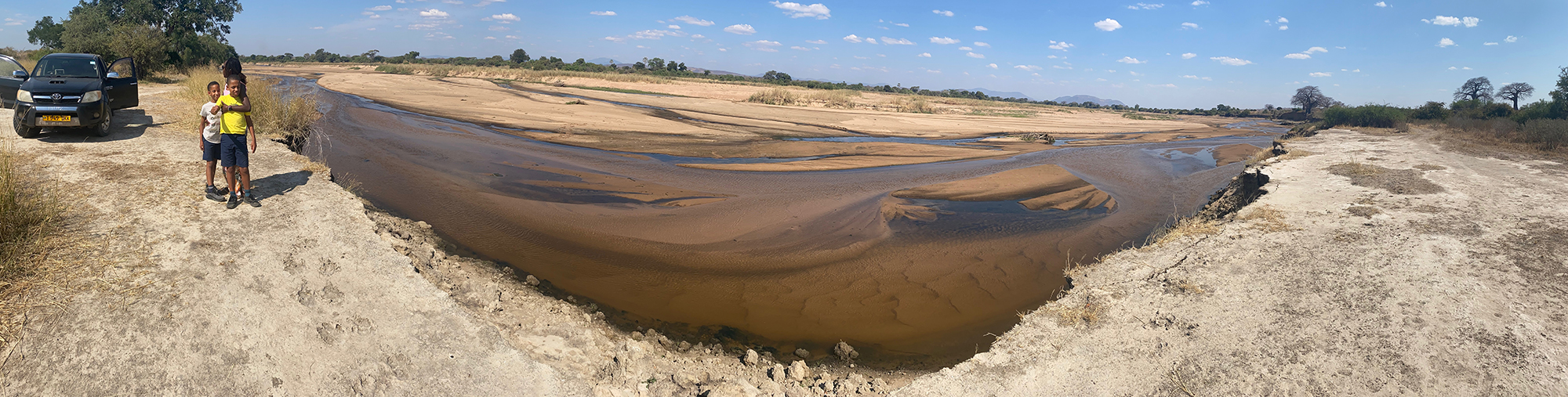
    The next camp was not on iOverlander but signposted Mbega Executive Camp, and not far from Hippo Camp. The access road was overgrown but driveable, and it didnt look promising. We arrived at the parking lot and were about to turn around when someone appeared. He said the camp was closed while it was being rebuilt. Earlier that year there had been major flooding in the Rufiji, caused by El Nino. It was made worse when the new hydro-electric project upstream had to release huge quantities of water to prevent the dam from failing. We had a look around and the damage was condsiderable; they had lost several bandas and about 10m of river frontage. The camps in this area are all perched on a high cliff top on a bend overlooking the river. The cliff is just compacted sand, so just collapses when the river floods. I recall my GCSE Geography at school on how rivers undercut their banks to create meanders. I fear all of these camps are unfortunately doomed, especially with more frequent El Nino events and higher rainfall in the region. Hippo Camp has been abandoned, the owners having cut their losses.

    The guy who showed us around told us that the next camp along the river, called Selous River Camp, was open and just a short stroll away. We went for a look, and were immediately very impressed. The camp pitches didnt have a river view (the river views were reserved for the bandas). The bar & restaurant and relaxing area have a spectacular river view. They even had a small swimming pool (which was newly rebuilt after falling into the river during the floods). For one night for 4 of us to camp, with a hearty meal and drinks was around $100 USD. The sunset was spectacular.

    A small, thin very dark-coloured snake with black eyes and a lighter underside came through the bar area at night. We got a good close look at him but nobody there could identify what species it was. It was pretty relaxed. I don’t think it was a Black Mamba, but not sure or daft enough to tempt fate by trying to pick it up.

    Selous River Camp – view from the bar area
    Rufiji River sunset

    Day 83 – Game drive through Nyerere NP

    We left camp at 7.30am and entered the park. We saw a female Elephant and her calf on the way out of the campsite. We entered the park quite quickly because the gatehouse internet was not working and the staff couldn’t take payment. We then spent around 7 hours doing a game drive along the river and around the lakes. It is very pretty here but we didn’t see much wildlife. There were plenty of Giraffe, Impala, Hippo & Crocodiles. We saw some Buffalo, Kudu and Wildebeest but no Elephant (although there were plenty of signs of Elephants around) or predators.

    We left the park at the western gate (Matambwe) around 3.30pm and drove towards Sumas moms house in Morogoro. There is another route to Morogoro which I havent tried before; It leads from Kisaki, heading west and then north to Mikumi National Park. We asked in Kisaki as to the road condition. The locals informed us that the road is no good; only the park rangers use it, and we would need a park permit; it leads through part of Nyerere NP and also Mikumi NP. We headed back to Morogoro on the better dirt road skirting the beautiful Uluguru mountains. We arrived in Morogoro at 7.30pm, the last hour being in the dark on a busy dirt road. My super-bright headlamps were invaluable here.

  • Tanzania & Malawi road trip – unfinished post

    Tanzania & Malawi road trip – unfinished post

    My cousin Hannah and her fiancee Martyn were due to get married in Malawi on 10th August 2022. Suma has family in central and southern Tanzania. It seemed that a road trip was in order, and we had 6 weeks in which to do it…

    Dar Es Salaam

    We hung out in Dar for a couple of days with Suma’s brother Jones, it was great to catch up with him again. 

    A priority was to get some new tyres fitted to Graces’s Hilux, so we headed to the embassy district to get some fitted. While up on the ramps we could inspect the car for some long-overdue repairs that needed doing. It was obvious that the truck had been roughly treated and badly maintained.

    We drove up to Ndege (bird) beach near Sumas beach plot at Mbweni JKT, just north of Dar for the day, while Suma got some new mini dreadlocks fitted (sista-locks). The kids played on the beach while me and Jones caught up in the bar/restaurant. Ndege beach is developing a little, there is a new bar & restaurant being built. The beach needs tidying up a bit. 

    Morogoro

    The Uluguru mountains overlook Morogoro, you can see them from many miles away on the approach to the sprawling town that is the regional capital.

    They are part of the Eastern Arc mountains, a group of isolated mountains which rise from a large plateau. The ancient forest on them dates back to when all of East Africa was covered in dense rainforest. When the climate dried, the land turned to savannah. The mountains retained their rainforest to this day, and continue to catch rain. Even in the dry season, there are often clouds on the mountains. Surrounded by dry savannah, the mountains are isolated from each other like islands in an ocean, and so endemic species have evolved (found nowhere else in the world).

    If you hike up to Morningside (the abandoned German mansion halfway up the mountain), you will walk past terraces growing strawberries. Further up you can walk towards the densely forested nature reserve. It is lush, beautiful and primal, a snippet of true African rainforest.

    There are few animals left in that forest though. A few monkeys and thats about it. Further east the Udzungwa mountains cover a larger area and are better protected, being a National Park. 

    We spent a few days in Morogoro enjoying our time with Grace, visiting a plot of land near Mzumbe university, looking at a plot in Naninani, visiting Timothy’s grave. There is a section of the cemetary set aside for the victims of a recent fuel truck tragedy. A fuel tanker tipped over, and crowds of people were using buckets, bottles and whatever containers they could find to mop up the spilling fuel. Someone caused a spark while stealing the truck battery, and the resulting inferno incinerated over 100 people. The sad thing is, this has happened several times before in Tanzania. 

    Vehicle repairs: Oil change, some welding, brakes, new front stabilisers, new clutch.

    Day trip to Mikumi. Last time we visited Morogoro I passed up the opportunity to visit Mikumi, and regretted it. So this time I made sure we went. We had a great day driving around this relatively small park. We just opted for a self drive tour of the various dirt roads that criss-cross the park. The A7 cuts right through the middle, so stick to the speed limits and make sure you dont hit any wildlife. There are large fines for injuring or killing animals. 

    We spent some evenings at Dragonaires bar, it is great place to hang out of an evening. Good, cheap food and drinks. We took a walk up the mountain, but it wasn’t too successful. The footpath started out easy enough to follow, but soon turned into a network of small tracks that were difficult to follow. They were just tracks used by charcoal burners, and we saw loads of charcoal pits. 

    Looking up at the mountain from Graces house, you can see columns of smoke from charcoal fires right up on the higher inaccessible parts of the mountain. I worry that at this rate the forest will disappear within the next few years. With no tree roots to bind the dense red soil together, the slopes are so steep that there is a real risk of devastating landslides during the intense rainy season. The settlements continue to expand up the hillside, with the poorest building mud-brick houses onto terraces cut into the hill.     

    Dodoma

    Leaving Morogoro around 10 am we headed to Dodoma, the capital of Tanzania. Sumas niece Mira lives in Dodoma, so we wanted to go see her. Jones has a house there, and we could stay there overnight. After many uneventful hours of tar-road travel, we arrived in Dodoma. By the time we arrived it was late afternoon. Cousin David volunteered to go fetch Mira from her moms house. About 4 hours later he eventually arrived with her: Mira’s mother (estranged from Sumas brother Maka) had, rather spitefully, not told her we had come to see her, so no arrangements had been made. As a result we only got to spend 2 hours with Mira, a real shame.

    Police blocked the roads to allow a Presidential motorcade to pass, leading to a crazy scrum after it passed. It is not uncommon for police or soldiers to stop traffic and force cars off to the side of the road. You will wait there for maybe half an hour or so. Then a fleet of black shiny Land Cruisers, Army troop carriers or both come thundering past. It could be a high-ranking politician or important army general. 

    Another uneventful tar-road drive to Iringa. 

    Ruaha

    Tandala Lodge, notes about Iringa. Almost hit a Kudu, almost ran over a Cobra.

    Pretty rough roads in places. The corrugations were so bad in some places that the truck went almost sideways at times, skipping and bouncing around due to no weight in the back. At Tandala they owners said that the road was usually worse than this.

    Iringa

    We left the smelly rustic chalets in Ruaha National Park by noon and began the drive back to Iringa along the dirt road. The steering began to feel a bit unstable, so we stopped at the next village,Tungamalenga. I looked under the vehicle and the stabiliser (which we had replaced in Morogoro) had come off. The mechanic hadn’t tightened the nut up properly, and it had worked loose and stripped the thread off. The loose stabiliser then damaged the drive shaft rubber boot, which came off, allowing dust to get in places it shouldn’t.

    Within minutes of saying to a shopkeeper ‘naomba fundi’ (I need a mechanic), a guy appeared with a few basic battered tools and managed to do a quick fix to get us back on the road, while a local drunk unsuccessfully tried to beg some cash for more booze. We gave the mechanic our sincere thanks and a few shillings for his services then headed off. 

    Not much further along the road I was amazed to see an old Land Cruiser at the side of the road with its wheel missing. Not just the wheel, but the whole hub assembly had fallen off. A family from Iringa were having a bad day on their way back from a tour of Ruaha. The road was rough for sure. A woman with 3 kids were sat in the shade while the 2 men were busy trying to reattach the wheel. We stopped and asked if we could help in any way, and it was agreed that the best way we could help was to give the mother and children a lift back home to Iringa. There were 3 adults and 5 kids all snugly crammed into the cab for a couple of hours. 

    After taking the family home, we headed to the famous Sunset Hotel Iringa Hotel. Its not cheap but it is very nice. Normally for a family room in a basic & clean Tanzanian hotel we would expect to pay around 25-30 USD per night. The Sunset Iringa is superb, but more like 55 USD per night and with great evening meals and a fantastic breakfast. Some of Reece’s fondest memories of our Africa trip are the food he ate at the Sunset Iringa Hotel.

    We needed the front stabiliser to be fixed properly as the village mechanic was only able to do a temporary fix. The threaded bolt was an integral part of the stabiliser, so the whole part needed to be replaced (again), and the rubber boot. The helpful hotel manager got his mechanic to come and collect the truck, he then brought it back to us with the repair done. He did a good job too, although the rubber boot did keep working loose until we could find a big enough jubilee clip.

    Mbeya

    After leaving Iringa we headed down to Mbeya to visit Sumas family. Around 20 miles outside Mbeya we had a puncture on the rear. Not able to pull over safely on the deadly main road, I drove for 200m and turned into a dirt road leading to a small settlement. Unfortunately the new spare we had fitted in Dar a few weeks earlier had not been set properly and the air had leaked out. So now we have 2 flat tyres. We get chatting to some friendly locals, one of whom phones his friend who has a motorbike. A guy on a motorbike soon appears, puts our wheel on his carry-rack and takes it to get it repaired. About an hour later we are back on the road, and i cannot thank our new friend Daniel enough for his help in getting us on our way. Genuiney nice people, happy to help out some strangers. A perfect example of the kindness of Swahili culture.

    With all the vehicle issues we arrived quite late to Mbeya, and Sumas family directed us to a hotel not far from their house, where we checked in and went to tea with Sumas aunt.

    The next day we needed some more vehicle repairs. The new clutch that we had fitted in Morogoro was slipping. A relative found someone reliable to adjust the cable and it fixed the problem. It was getting a bit annoying having to get jobs re-done that had been bodged by the Morogoro mechanics. 

    So after saying our goodbyes, we left Suma’s aunt, uncle and cousins the next day and headed south to Tukuyu to visit another uncle. 

    Tukuyu

    The relatively short journey to Tukuyu was uneventful. The road winds up from the dry region surrounding Mbeya up around the lush foothills of Mount Rungwe and Kitulo National Park. Mount Rungwe dominates the scenery of the area, and there are excursions that you can do up to see a volcanic lake and waterfalls, plus visit the park. 

    Tukuyu is the main town on the road from Mbeya to the Malawi border, and is where Sumas mother grew up. Her family has land nearby, managed by uncle Fred. We visited uncle Fred, who treated us to some delicious food and tea, all locally-grown. We stayed at the main hotel in the centre of Tukuyu, it is very cheap and clean and serves as a good base to explore the surrounding area. Weekends sees the hotel hosting wedding parties, so expect loud music until midnight on a friday & saturday.

    The next day Fred proudly showed us around his farm, which was a mix of banana, cassava and avocados all growing together and beautifully tended by himself. He is in his 70’s, but looks 20 years younger and is fitter than a butchers dog. Here the land is very fertile and the sun and rain are in abundance, creating perfect growing conditions for crops. You can almost see the weeds growing. The neatly raked soil on Freds farm indicates how much work he puts into keeping this lovely patch of terraced hillside manicured and in perfect condition.

    Tukuyu to Mwakaleili

    After saying farewell to Fred we headed off down a long dirt road towards Kandete Mwakaleli to see the local legend that is Mzee Isa, the man who raised Sumas father Timothy. Kandete is 2-3 hours drive out into the bush, and Timothy was from a very small village even further out into the bush. 

    He saw great potential in his nephew from the village: the intelligent young orphan Timothy. Mzee Isa took Timothy from the village and raised him as his own, putting him through education. Timothy eventually become a respected professor at Mzumbe University. 

    Despite the language barrier, you can see Mzee Isa is an extremely intelligent man. He is known, respected and loved by all in his community. Tanzania is a devoutly christian country. As with many Tanzaians, Mzee Isa is deeply religious. When Suma told him that I dont believe in god, rather than being amazed and puzzled, his response was thoughtful and pragmatic. “Well” he said, “He seems to be a good guy and is honest about his beliefs. I would rather someone be truthful than lie or tell people what they want to hear. There are people in this country who go to church every sunday and prey to god but do not live godly lives. They say one thing and do another. ”

    Mzee Isa managed to get a message to Sumas favourite aunt Salome (from her fathers side), who lives in the remote village where her father Timothy was born. We had been struggling to contact her, and Suma really was desperate to see her. The next morning, on the day we were due to leave, we were woken early by a cockrel crowing really loudly right outside our bedroom window. I jokingly remarked to Suma my desire to kill and eat it for dinner. 

    After getting up, we realised that aunt Salome had arrived. The cockerel was hers, and she had carried it and a sack of bananas all the way in from the remote village, along with her daughter and newborn grandaughter. They had been walking since 5am to reach us, worried that they may have missed us. 

    Now aunt Salome is extremely poor. She lives a subsistence lifestyle, eating only what she can grow. For her to give us a cockerel when she struggles to feed her own family was not lost on us. It was gamey and delicious when we ate it for lunch, prepared for us by Salome and cousin Bless who was visiting from Kyela.

    We were really keen to visit Salome’s village, so offered her and her daughter + baby a lift back home. After an hour trundling down a dirt road we arrived at a small village. It is surrounded on all 3 sides by the verdant steep-sided ridges of the Mt Rungwe foothills and The Livingstone Mountains. 

    We had to travel the rest of the way to her settlement on foot, crossing over a river using a fallen tree. Intense rains caused flash floods the previous year and had washed away the footbridge and changed the course of the river. It had also almost washed away some of the houses too. 

    The settlement was a collection of 4 mud-brick houses around a central courtyard, rendered and capped with corrugated tin roofs. There is no electricity or plumbing, although water is in plentiful supply from the nearby river. Each house was owned by one of the wives of the late village elder. One of those wives had recently passed away so the settlement was full of relatives who had come to pay their respects. 

    We were welcomed into one of the houses, inside the soot-blacked hut were 3 old ladies sitting around a central fireplace, more distant relatives of Sumas. When we were introduced to them they stood up and gave us all big warm hugs and big smiles. 

    Im so happy that the kids got to see where their grandfather was born and raised, and to meet some of their distant relatives.  Life has changed very little here since Timothy was born. It is very remote, the people are very poor.      

    Mwakaleli to Matema

    Truck blocking the dirt road by trying to reverse into a field. The very beautiful drive back to Tukuyu and Matema was interrupted by a speed trap.  

    Matema is a quiet picturesque fishing village on the northern tip of Lake Nyasa, more commonly known outside of Tanzania as Lake Malawi. It is part of the rift valley, and the pleasant drive down to the lake from Tukuyu is a journey through stunning ancient volcanic formations carpeted in rainforest with the lower slopes blanketed in banana & tea plantations.

    Matema is bordered on 2 sides by the Livingstone mountains, rising up like a green wall from the lake shore.

    We stayed in the Palazzo Garden Resort hotel in some newly-built bungalows with secure parking. We stayed in the bungalows because Suma liked the shiny bathrooms. The bungalows are very modern, clean and comfortable. The remind me of 4 star hotel rooms in the Mediterranean. The food is pretty basic. The staff are very welcoming, and the place appears well-managed. It is popular with Tanzanians who come down from Mbeya for the weekends. 

    There are some nice lodgings not far away at Matema Lake Shore Resort. They 2 storey chalets have plenty of character, facing directly onto the beach with wonderful views. The restaurant caters for international guests so the food is better than at the Palazzo.

    Matema is a great place to kick back and relax for a few days if you’ve been on the road. We liked it so much we stayed for 5 days. Theres a nice slow pace to life here. It is definitely off the tourist trail, so there are no Maasai pestering you to buy bracelets like on Zanzibar. The water is clean and safe to swim in. We walked west down the beach towards where a river flows into the lake as we were told that there are crocodiles and hippos there. We saw neither, but there are definitely hippos there as you can see their footprints.

    We also hiked up to Mwalolo falls. We paid a guide to show you us the route, and paid a small entrance fee which goes to the local community. There is no path. I was expecting something like Dovedale. It is more like a mixture of canyoning, bouldering and rock scrambling. Its a bit sketchy in places. Its very pretty though, and well worth the effort. You’ll feel like Dr Livingstone. Reece complained a lot, Josh took it all in his stride and Suma was panicking in some of the more sketchy places. 

    Matema to Songwe border post

    Getting out of Tanzania was no problem, a simple formality of filling out forms and getting passports stamped. You then cross the bridge over the Songwe river and then deal with the Malawian immigration. We needed a letter from Suma’s mom stating that it was ok for us to use her vehicle in Malawi. We didnt have this, but a fixer soon managed to produce one, which just needed one of us to sign ‘on behalf of’ Grace. Job done. Now it came to the visas. Visa entry costs to Malawi for foreigners are $50 USD pp. It is clearly stated on the Malawi government website, and you have the option to buy your visa online in advance. The Malawian officials decided that today it was $75 USD pp, adding $100 USD to the cost of 4 of us. Our protests were met with an indifferent shrug and ‘You should have got your visa online, and if you dont like it, go back to Tanzania’. This is clearly a scam, and they are all in on it. There is nothing you can do. An overland coach trip was crossing at the same time as us. One of their party was from Brazil. He had to pay $150 for his visa. The reason for this was given as, ‘Well, Brazil is a dangerous country. Visa is more expensive’. Next time I cross into Malawi via a land border, ill be buying the visas in advance, assuming the website actually works. Our relatives who flew directly into Lilongwe paid $50 USD. Visa scams are easier to enforce at remote border crossings than at international airports! 

    Songwe to Nkhata Bay

    After the hassle at the border it was nice to be back in the car and driving again. Already there was a noticeable difference. You could easily tell you were in a different country. Malawi is possibly the poorest country in Africa. All along the Tanzanian highways there are cars, motorbikes, taxis, trucks, and coaches everywhere. There are markets, shops, stalls, businesses and houses everywhere. The houses are mostly rendered and neatly painted, with corrugated metal roofs of various styles and colours. Theres just lots going on. The place is thriving.

    Not so in Malawi. The first thing we noticed was the lack of vehicles on the road. Next are the houses: small, mostly mud-brick construction with thatch roofs. It looks like they have to keep rebuilding them – many seem to be returning to the earth from which they were made. 

    Time was ticking so we found a lodge on the lakeshore. I forget the name of it as we only stayed one night. It was basic, quiet but nice. This was when we had our first inklings of the Malawian electricity situation. Or lack of it. Power was off in the morning when we woke. Rather than have a cold shower in a dark room, I chose to go and wash in the lake like everybody else does in Malawi. Very refreshing, I can get used to this. It seems that power is only on during the evening, from around 8pm to 6am, and it varies. Sometimes the power is on during the day, sometimes not at all.  If you have devices to charge up, then plug them in overnight. We carry a 4 gang extension lead so we just use one plug socket to charge up the phones and the laptop. Conveniently, despite the power grid being down, the phone masts still work so you still get phone reception.

    Its impressive that the country functions at all with that little electricity. If the UK had the same power situation, we would be eating each other within a week. Maybe the lack of electricity is one thing holding Malawi back. Solar tech could definitely make a difference here. 

    So next day we pack up and head towards Nkhata bay, a small fishing village in a sheltered bay. After looking at a few options we decided to stay at Mayoka Village. I wasnt too overjoyed at paying $55 USD per night for a family chalet. But on reflection I was being excessively tight-arsed about it. The site comprises chalets and a restaurant nestled in a hillside littered with enormous boulders. Everything is built around or on these boulders, with a newtork of paths, steps and walkways linking them all together. Our stilted chalet was right on the lakeshore, with a large deck protruding over the lake. There was no beach, but access to the lake is via steps over boulders and swim platforms. The resort is popular with backpackers, and its easy to see why. 

    The food and drinks are fantastic & well priced. They have kayaks that you can use to explore the bay. Also there are a lot of excursions that can be booked directly from the restaurant area. You could easily spend a couple of weeks here. We only stayed for 2 nights though.

    Nkhata bay to Nkhotakota NP

    We continued south. I saw from our map that the next logical place to stop was Nhotakota, with the option to explore the nearby national park of the same name. This is pronounced hota-kota, with a barely audible ‘nk’ at the start.

    We saw a sign for Fish Eagle Bay lodge, so decided to take a look. It looked nice so we decided to stay for the night. Nice food, cold beers and a friendly manager who I felt could have been a highly successful academic if he had the same opportunities we have in the west.

    As with many beach lodges we came across in Malawi, your house/chalet is right on the beach.The food is simple but fine, the staff are friendly, the electricity is mostly switched off. A pattern was emerging! Coming from land-locked Birmingham dont think i can will ever get tired of walking out of my front door and stepping onto a stunning deserted beach. And the prices of these amazing lodges are really cheap too.

    The first night at there a strong wind picked up on the lake, and our sleep was intermittent due to a howling gale whistling through the chalet. We thought about packing up and leaving in the morning, but the manager appeared and apologised profusely – there were shutters on the windows that they normally close during the evening, but he forgot and we didnt know that the shutters were there. Now we knew about the shutters, and because I was keen on exploring Nkhotakota National Park, we decided to stay another night.   

    The drive to Nkhotakota NP was about an hour and a half. While Suma paid the (very cheap) park entry fees i gave the car a quick look over. The rubber boot had come off the front drive shaft, so i got my hands caked in grease forcing it back on. I found that mixing sand with liquid soap makes a fantastic swarfiga and gets the grease off in no time. We were allowed to self drive, but had to take an armed guide with us. He had a slick-looking M-16 and sensibly wouldnt let me play with it.

    The National Park has been around for many years, but has suffered poaching on an industrial scale. Until recently there were very few animals left in the park, so nobody bothered visiting it. African Parks have taken over the management and are trying to turn things around. Hides are being built, animals are being reintroduced from the Liwonde NP in the south of Malawi, there are education programmes, and there are armed anti-poaching patrols. 

    By killing the elephants and other herbivores the vegetation has grown quite thick so its difficult to see much of the wildlife. We did come across one herd of elephants. We were driving down a single track dirt road with very dense forest either side of us. We could see that there were elephants nearby – fresh poops and shredded trees branches everywhere are sure signs. 

    Now this is a potentially dangerous situation. In the dense bush, elephants cant see you, and you cant see them. Wherever you are, sneaking up and surprising an elephant is not a good idea. Even a modest-sized elephant could easily flip a car if it wanted to. Elephants here have been either hunted by humans or forcibly relocated from elsewhere, not exactly endearing them to humans. 

    The potential for things to turn ugly are very real, and an M-16 isnt going to stop an irate bull elephant!

    We stopped and wound down the windows, listening. Up ahead, about 40m, several elephants came out from the bush on the left and crossed the road. They clocked us and the guide advised me to reverse, which i did. We found a spot where i could turn around, so i manage a very quick 7 point turn and we headed back the way we came. 

    Up ahead of us, another herd of elephants appeared out of the bush, so we stopped. We were sandwiched between 2 groups of unknown size and we didnt know where most of them were. The guide started to look worried, and this is when i started to get a bit concerned. It was the most worried I have been on any animal encounter.  

    The guide advised me to continue slowly, which i did until we were roughly level with one elephant still in the bush on our left. It gave out a loud trumpeting alarm, the guide shouted ‘go, go, go’ so I planted the foot down and we shot out of there. 

    We saw a few impala, and i accidentally ran over a puff adder (which i still feel pretty guilty about), but apart from that we didn’t see any other wildlife. It was an enjoyable drive through some lovely forest trails, and the elephant encounter was memorable. 

    They have a long way to go before it can rival the other parks in Africa, but at least they are moving in the right direction. If Malawi can offer a choice of superb safari experiences then it has the potential to be a world class tourist destination. They certainly have the most stunning beaches. 

    Nkhotakota to Cape Maclear

    We were sad to leave our new friend at Fish Eagle Bay lodge, and headed off towards Cape Maclear. I was under the impression that Cape Maclear was the tourism capital of Malawi; it is on all the travel sites and everybody who comes to Malawi comes to Cape Maclear. So I was expecting a sort of Africanised Benidorm. I couldnt have been more wrong! It is in fact a quiet fishing village with a handful of lodges, restaurants, craft shops and small hotels scattered along the shore.

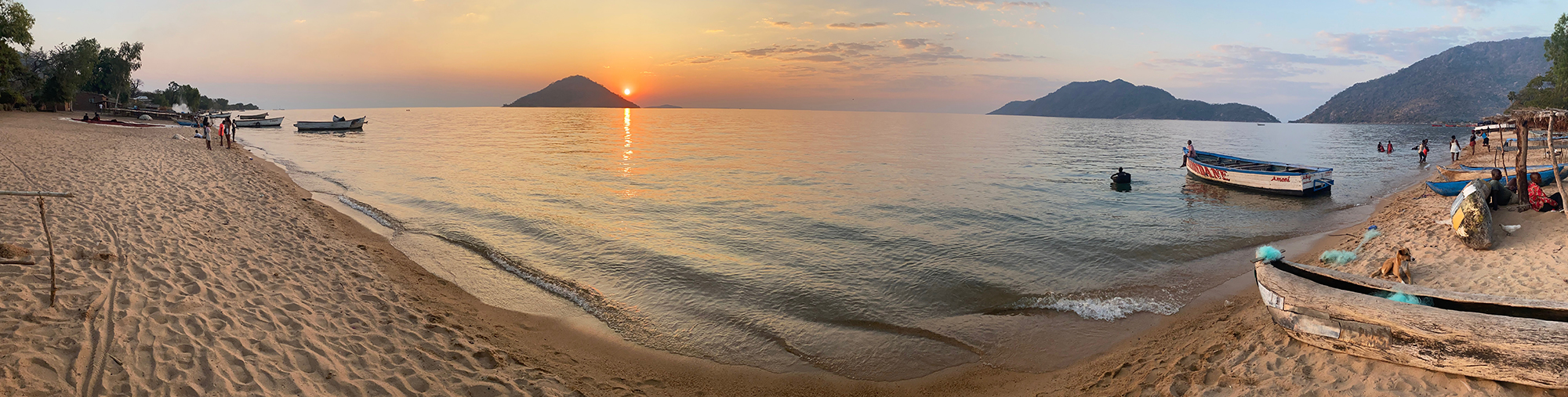
    Each evening a fleet of small dugout canoes and small motorised boats head out from the beach to spend the night fishing out on the lake. In the morning the men and boys return with their catch. The women spread the fish out on drying mats and repair the nets. It is a life that has changed little in centuries.

    Cape Maclear is in a gorgeous sheltered bay on a peninsula jutting out into the lake, and has the benefit of being west-facing. As most beaches in Malawi face east, this is the only one with lodges where you can see a sunset. And what a spectacular sunset it is! I took so many sunset photos. We spent 3 nights here, but could have easily stayed a lot longer. 

    Things to do in Cape Maclear:

    Most activities are centred around the water. The Cape is in a nature reserve, both the land and the waters in bay are included in the reserve. The main attraction is the uninhabited offshore island which is protected, together with the water that surrounds it. Anybody who keeps tropical freshwater fish will know about the famous Ciclids found in Lake Malawi. They are almost as brightly coloured as fish youll see on a coral reef. Visiting the island and swimming with the Ciclids is a must. 

    We did a trip in a small motor boat, just 4 of us plus a guide. We spent the whole day there, snorkelling with the Ciclids, relaxing on the beach and paddling in the lake. Fish eagles perch in the trees above, noisily calling to each other.

    Since they are protected from fishing, there are so many fish here. Drop some dried bread into the water and you are instantly surrounded by a shimmering mass of Ciclids, forming a wall of fish so thick you cannot see through it. Spectacular.

    Before heading back to shore, the boat took a small detour where the guide threw a couple of pre-caught fish into the water. Fish Eagles then came swooping in to claim them.  

    Our boat trip was 100 USD for the day, which was quite expensive by Malawian standards. But then it was a private boat trip, and the guide made us a fantastic lunch: a large catfish cooked on a barbeque with rice and vegetables. It would be a lot cheaper to rent kayaks and paddle over – its a sheltered bay so is quite safe, and its not far to reach the island.

    Nkhudzi Bay

    Ddddd

    Senga bay

    Wedding

    Heading back to Tz: border crossing, stay in Iringa, back to Morogoro in 3 days from Senga bay.

    Visiting Nyerere NP, Last week in Kigamboni on the beach
  • Tanzania Southern Circuit

    Tanzania Southern Circuit

    January 2, 2025 8:40 pm

    Tanzania Southern Circuit

    • Distance Instructions

    Almost everybody who comes to Tanzania for a safari goes up to the northern part of the country, home to the world-famous Serengeti, Tarangire, Lake Manyara and Ngorongoro National Parks. Mount Kilimanjaro is also up in the north. As a result, the northern parks are extremely busy. It is not uncommon to see 50-plus vehicles surrounding a leopard or lion kill, which can detract somewhat from the sense of wilderness. The lesser-known southern parks are no less stunning and benefit from having far fewer visitors.

    This southern circuit route will take you west from Dar-Es-Salaam on the Indian Ocean coast line to Matema on the northern shore of the rift valley Lake Nyasa (Lake Malawi). It will take you through the National Parks of Nyerere (Selous), Udzungwa, Mikumi and Ruaha, with options to extend the trip either into Malawi or up to Lake Tanganyika and the national parks of Katavi and Mahale.

    Nyerere and Ruaha National Parks are both spectacular places to visit. Udzungwa & Mikumi are less impressive in comparison but are still worthwhile day trips if you are in the area.

    A blog of our route is ****LINK NEEDED*** here 

    Dar es Salaam To Nyerere NP (formerly Selous):

    This route takes you from Dar es Salaam to Nyerere National Park down a well-maintained dirt road. Coming this way you will avoid the endless police checkpoints and dangers of the Dar to Morogoro highway. The dirt road was in great condition in 2022 and passes through lush green coastal plantations and pretty villages in rolling hills from Kisarawe becoming ever more remote towards Kisangire. From here you head towards the exclusion buffer for the park, so it will start to feel like you are in the wilderness. Parts of the road were being rebuilt in 2022 so there were many diversions off to the side which required 4WD to get through the sand. It is around a 6-hour drive, but it is a journey to be enjoyed rather than endured.  

    Mloka village is just a 10-minute drive from the eastern park entrance gate, and also where all of the lower-cost riverside safari lodges are located. If you drive in from Morogoro (early start) you’ll be at the western Matambwe side by lunchtime, and you will need to pay to transit through the park to get to Mloka. You will pay the same high park entrance fees to transit through. Staying inside the park at the luxury lodges is way out of our budget. Tanzania isn’t a cheap place to go on safari! 

    Places to stay near Mloka:

    You are spoilt for choice here, there is a lot of choice to cater for all budgets. We have stayed at the cheaper Butembo Lodge, and also at Selous Mapumziko Lodge. Both are riverside sites, and I’d say Butembo has the better views of the river but it was closed in 2022. Mapumziko has a large grassy sandbank in front of it which blocks the river view a little. Both have great friendly staff and decent food. Black and white Colobus, Blue monkeys & Vervet monkeys are ever-present. Rates I can’t fully remember but around USD 150 per night for a 4-berth luxury family canvas tent, all-inclusive. You will want a 3-night stay minimum to have 3 good days’ worth of game viewing.

    Selous Butembo staff with our family
    Spotted an Elephant near Mloka, outside the park. It came within inches of us

    Wherever you decide to stay you will need to book ahead a few days in advance – Mloka is quite remote so supplies have to be driven in from Dar Es Salaam. They don’t keep staff and supplies on hand to cater for people turning up unannounced.

    While at Mapumziko we managed to track down an old friend Felix we knew from Butembo, who is now working as a guide out of Selous Jimbiza camp (also near Mloka). He took us to look around Jimbiza, and it looks fantastic. The camp is located high on a cliff on a bend in the Rufiji River, so the views across the river are spectacular.

    ***2024 UPDATE*** In summer 2024 we stayed at Selous River Camp. Heavy rain fall earlier in the year had caused a lot of damage to the cliff-top campsites, some were closed permanently. We did not check in at Jimbiza. Selous River Camp is fantastic – we arrived without booking ahead and secured a camp spot there.

    All lodges will arrange boat trips, where you’ll get to stand on a sandbank in the middle of the river and watch the sunset. You’ll see plenty of birds, Hippos and Nile crocodiles. The boat trip is definitely a worthwhile excursion.   

    Sunset on the Rufiji River during a spectacular evening boat trip
    Inside Nyerere National Park:

    The vast expanse known as Selous Game Reserve has now been renamed Nyerere National Park. The largest part is the remote inaccessible southern section. All of the game-viewing trails are in the northern part of the park on the north bank of the mighty Rufiji River. It is stunning here. It has a variety of habitats centred around the river: miombo woodland, lakes and semi-open savanna. A diverse range of habitats makes it very interesting to explore – you never know what is around the corner. 

    The dry season sees large amounts of wildlife congregating around the river and its many nearby lakes and waterholes. Although the park contains the ‘big five’, you will need to be very lucky to see Leopard, Cheetah or Rhino. The Rhino are in the inaccessible southern part of the park so you won’t see them.

    Stopping for a quick snack near one of the many lakes fed by the Rufiji River

    With a 4WD and a GPS map it is pretty easy to do a self-drive around Nyerere without needing a guide. There is one main dirt road that runs roughly west to east between the park gates, and the rivers and lakes are south of this main road. Loads of sand tracks and gravel roads branch off south and wind around through open savannah, thorn bushes, baobab trees, pockets of woodland and lakes. Slowly meandering through all of this stunning scenery you’ll come across huge numbers of wildlife: Elephant, Giraffe, Kudu, Warthogs, Zebra, Buffalo, Impala plus Hippos and Crocodiles in and around the lakes.

    If you want to see lions then it’s best to arrange a guide through your lodge. The guide will even drive your car so you can spend more time looking out of the window at the wildlife.

    Since upgrading to National Park status the entry fees have increased and are now the same as the more famous northern parks like Serengeti and Ngorongoro.

    Giant Baobab picnic spot in Nyerere N.P.
    Try to resist the urge to tickle its belly!

    The government are building a hydroelectric power station and dam across Steiglers Gorge south of the western gate. From dawn till dusk heavy trucks are rolling through the park, kicking up thick clouds of dust. Since most of the wildlife isn’t near the main road, it won’t affect any game drives. If you are in an open-top safari vehicle travelling down the main road, the truck drivers have all been instructed to stop until you pass, so as not to cover you in dust. I’m unsure as to when the work will be complete. The effects of damming the river will be to regulate the flow during the wet season. Time will tell as to the long-term effects this will have on the ecosystem.

    Nyerere to Morogoro:

    You have 3 options to get back to Morogoro, each has its plus points and negatives.

    Option 1: Head back the way you came (towards Dar), then turn north to Mlandizi on the A7 Dar to Morogoro Road. This is longer at 6-8 hours, but since you don’t go through the park, you don’t pay any park fees. 

    Option 2: Head through the park to Matambwe gate, then to Kisaki and the established dirt road to Morogoro. Maybe get up early so you can explore the western part of the park and get some use out of the park entry fees.

    Option 3: Again head through to Matambwe and on to Kisaki, but take the less established dirt road to Mikumi. This is more of an adventurous route, and may not be passable. On Tracks 4 Africa it is currently showing as ‘not recommended’. Local advice in Kisaki would be useful before attempting it. It is a drive I will definitely do one day. 

    Mikumi NP

    Ruaha NP

  • Self-driving through Tanzania: what you need to know

    Self-driving through Tanzania: what you need to know

    If you have the time, driving is the best way to explore the vast and beautifully diverse country that is Tanzania. Driving in Tanzania can be both liberating and terrifying. There is no idiotic road-rage nonsense because nobody cares about road rules.

    There is a degree of freedom that you just don’t get in the Western world. If your vehicle will physically fit somewhere, nobody will bat an eyelid while you try to fit it there. If you have driven in any developing country before, you will be well prepared for driving in Tanzania. You drive on the left-hand side of the road.

    Driving here can be a world of extremes: sheer bliss pottering along quiet mountain or savannah roads, or the terror of having to swerve out of the way of an oncoming coach. The inner-city and main inter-city roads are a real pain in the arse. The minor roads and dirt roads are awesome.

    Hiring or shipping your own vehicle are both options. For hiring, you can get a budget Toyota RAV4 or go all out and hire a properly kitted-out overland vehicle. We have travelled with both, and both work well. For the budget car hires, make sure you check the tyres all around, including the inside side walls for damage or bad repairs. Check the condition of the spare tyre, and that you have everything you need to change a tyre. Punctures are common.

    For the most part, the tar roads are in reasonable condition, you won’t need a 4WD to drive tar roads. National Parks will require 4WD vehicles. Capable off-roaders such as Land Cruisers, Defenders & pick-ups are best. Smaller SUVs like the Toyota RAV4 may have issues gaining entry to some parks, even in the dry season. The rangers don’t want to keep having to rescue stuck vehicles. 

    Unofficial highway rules:

    Generally, the bigger the vehicle, the more priority it has on the highway. Pedestrians & cyclists are at the bottom, and trucks and inter-city coaches are at the top. As far as I can tell, motorcycle taxis (boda-bodas) don’t have to adhere to any highway rules, official or not. They seem to have no regard for their safety – they will undertake, overtake, pull out of side roads without looking and ignore red lights. Police are busy pestering car and truck drivers and don’t even look at motorbikers. If you ever need a taxi, I’d suggest a Tuk-tuk (bajaji) instead of a motorcycle taxi. You’ll live longer. 

    Dangers to be aware of:

    The main arterial roads, such as the Tan-Zam highway (A7 &A104) in particular, are extremely dangerous. The number of overturned trucks in roadside ditches are testament to this.

    Coach drivers display some of the worst, most dangerous driving you’ll ever see anywhere. The coaches are large with surprisingly powerful engines, and they seem more than happy to overtake HGV convoys, regardless of any oncoming traffic. Keep your eyes out for them. If they are behind you, its guaranteed they won’t be there for long. They will overtake and pull into gaps that aren’t there. If you see them coming towards you, they will probably be overtaking oncoming traffic and will be on your side of the road. You’ll have to slow down, stop or pull off the road to avoid a head-on collision.

    Trucks are generally very slow-moving and mostly seem to be in various states of disrepair. They generally dont pose too many dangers, apart from forming long nose-to-tail convoys that are difficult and dangerous to overtake. 

    The Kitonga mountain road between Iringa and Morogoro is steep and twisty, and is by far the most dangerous section of the Tan-Zam highway.

    Breakdowns: 

    If you break down or have a puncture on a busy road such as the Tan-Zam highway, your first priority should be to get off the road. If this means driving with a flat tyre for a few hundred metres to find a safe place that is well off the road then do it; it is worth destroying a tyre rather than risking being hit by another vehicle.

    If you break down and are stuck in a dangerous position on the highway, the locals have found a great solution to warn other road users, and you may choose to do the same: They drag piles of branches into the middle of the lane behind the vehicle, kind of like traffic cones in European road works. A small camp saw would be a useful addition to your toolkit.  When other road users see the piles of branches in the middle of the lane, they know that there is a stranded vehicle up ahead, and may consider slowing down. The traffic rules state that you need enough hi-hiz vests for all occupants and a warning triangle. Deploy these too. 

    Driving at night:

    Don’t do it by choice, it is not worth it. If you do get caught out (as happens sometimes), take extreme care. There is usually no street lighting. Pedestrians and cyclists seem to come out in force at night and are very hard to see. This applies to rural as well as urban areas. People use the roads as footpaths. You will come across 2 main types of vehicles while driving at night: those with no lights, and those with only a very bright main beam. I suspect the main beam is used to illuminate those who don’t have lights. Regardless, both invisible and blinding make for an unpleasant journey.

    Goddam police checkpoints:

    Between Dar-Es-Salaam and Chalinze (on the A7), there are constant speed traps and police checkpoints. Similarly in the north near Moshe and Arusha. Stick to the speed limit, and don’t overtake when there are solid (faded) white lines in the middle of the road. Watch out for speed limit roundels, they tend not to repeat so it is very easy to get caught out. Inter-city coaches do have their uses if you can stay behind one for long enough. They know where all the police checkpoints are, so will slow down in all the right places. Police checkpoints are everywhere on the main highways, more so on the approaches to built-up areas where there are changes in speed limits. They wear bright white uniforms and are easily spotted from a distance. By the time you spot them, it may be too late as their speed radar guns work extremely well.

    You will probably get caught speeding or crossing a white line at some point, and this is where you’ll get to meet some generally friendly Tanzanian traffic police. You will need to pay a fine (30’000 Tsh or £10 GBP). Not really a bank breaker but make sure you insist on getting a receipt or they will pocket it for themselves. If they say their receipt machine isn’t working due to a network error, just say you are happy to wait until it starts working again. The government have been trying to clamp down on corruption but it is still rife. They are cautious about being caught accepting bribes, but will still try to get bribes from people. Always be polite and respectful when interacting with the police. This is sensible advice wherever you are in the world.

    Dirt and gravel roads:

    These will take you to some stunning places and should be driven at a leisurely pace. Smooth gravel can lull you into picking up speed, then hit you with a large hole, washout or crazy corrugation. Make sure that your vehicle is in good running order. Its a good idea to check underneath the car from front to rear at the end of each day, or whenever you stop for a break. Stop and buy fruit or sugar cane from these remote roadside stalls. Some of the most delicious fresh fruit you’ll ever taste will be from these stalls. The people are friendly, and they need your business. Don’t be a tit and haggle over pennies. The price is plenty cheap enough.  

    If you dont have a 4WD, many gravel roads are still driveable. However, if you come across a section that is being graded/repaired then youll maybe wish you had a 4WD. In these areas they dump large piles of dirt & aggregate, then use grading machinery to scrape it around. Passage through these muddy & rutted spots can be tricky with only 2WD. The locals will be happy to give you a push. 

    Driving in the National Parks:

    Check your vehicle before entering the park. Inspect the tyres and running gear, oil and water. Kick the spare tyre to make sure there is air in it.

    You should stick to the roads and trails. There are plenty of them leading to all the best wildlife-spotting areas. Going off the trail could lead to you getting stuck, damaging the vegetation or getting fined by the rangers. In National Parks you are not allowed to leave the tracks, in Game Reserves you are.

    Stay in the vehicle, except at designated picnic sites. You may spend all day looking for Lions, and may think that because you cant seem them that there aren’t any. They are very well camouflaged, and doze in the shade during the heat of the day. If you need to get out of the car for a wee or change a tyre, do it in a wide open area, where there is no cover for predators to hide in. Leave the car door open and stay within 5m of the car. You and everybody with you should be looking around.

  • Tanzania – a brief introduction

    Tanzania – a brief introduction

    General info about Tanzania:

    Lying just south of the equator, Tanzania is located in the tropics and has a hot climate. They have 2 seasons: warm and dry, coinciding with the northern hemisphere summer. Hot and wet, roughly in the northern hemisphere winter months. 

    The landscape is very diverse: tropical islands like Zanzibar, Pemba, and Mafia. The whole mainland coast is lush and green with white sand beaches. Inland there are mountains, rainforests, and savannas offering a range of different habitats.

    In Tanzania, you will also find the world-famous Mount Kilimanjaro and the Serengeti National Park.

    Of course, Tanzania is also home to the Rift Valley system with the large lakes of Victoria, Tanganyika, and Nyasa (Lake Malawi).

    It is also thought of as being the ‘cradle of humanity’. It is likely modern humans evolved in East Africa; some of the earliest fossils of early hominid species are found here.

    A beach holiday combined with a safari makes this an understandably popular travel destination.

    Tanzanian food:

    The food here is delicious. Fresh produce, grown locally. Spices from Zanzibar & Pemba. Tanzania exports very little food. They don’t import much either. What they grow, they eat. Large parts of the country are fertile: lush green coastal areas, and verdant mountains in the south and west giving perfect conditions for growing. 

    You will hear the locals insist on being served only ’Mbeya rice’. A deliciously tasty rice only grown in the Mbeya region, but so highly sought after that none ever leaves the country. Traditionally Tanzanians eat buffet-style: 5 or 6 dishes laid out on the table, you help yourself to whatever you want. Boiled maize flour (ugali) and rice are staples, beans, peas, roasted ginger & lemon chicken, chips, beef stew, and potato stew can all be on the menu. Fresh fruits are usually on the menu for breakfast. Suma is a fussy vegan, and she has no problems with the food: many dishes are meat-free. 

    Street vendors sell a variety of tasty morsels:

    Kitimoto is very nice – it’s roasted seasoned pork. Mishkaki is savoury beef roasted on a skewer and sold everywhere,  it is always frustratingly chewy. Roast chicken is found everywhere in the towns and cities. 

    Boiled peanuts (ground nuts) are available. They are a lot tastier than they look. Fresh fruits are everywhere when in season. Mango, Papaya, strawberries, Pineapple, and many varieties of banana.   

    The local beer is pretty good: Kilimanjaro, Safari & Serengeti. Spirits: if they are in a glass or plastic bottle, all good. Sold in a plastic sachet: maybe avoid it.

    Currency:

    The local currency is Tanzanian shillings (TSh). US Dollars are widely accepted in tourist areas to pay for excursions and accommodation. Outside the tourist areas, you need to pay in TSh. ATMs are available in all medium-sized towns and the larger cities. It is a good idea to open an international bank account before you arrive. We bank with HSBC and the card can be loaded up with different currencies using online banking with great exchange rates. Cards can then be used without incurring any additional fees. 

    Cards can be used to pay for entrance into National Parks, they don’t accept cash.

    Communications:

    Upon arrival either at the border post or airport, you will find people selling phone data packages. Vodacom seems to be the best. The seller will install the SIM and set up your phone for you. You’ll then have a local telephone number to make hotel and excursion bookings etc, and a data package so you can access the internet. Your phone will need to be unlocked to any network. If you are on contract it’s worth looking into this and getting your phone unlocked before you get to Tanzania.

    If you have whatsapp, your number will be unchanged, so is the best way to call people back home. For local calls, many Tanzanians (ones not involved in tourism) don’t have data but use SMS and regular phone calls. 

    Phone connection in all urban areas is excellent. You will get good phone reception in all but the smallest villages. Even in the national parks, there is very good coverage (unless you go too far off the beaten track). The safari guides all use mobile phones to communicate with each other.

    I use a laptop for work purposes while travelling, and find that using the phone hotspot with a Vodacom phone data plan works really well. Checking emails, checking websites and Google Maps are all fine with a data plan. Just don’t go streaming movies or box sets.

    I’m amazed at how good the phone connection is in what is meant to be a ’third world country’. It is far better than in many rural parts of the UK.  

    Religious conservatism:

    It is a mostly Christian population on the mainland, with a mixture of Muslims and Christians on the coast, and Zanzibar is majority Muslim. It is a very conservative society, and away from the beaches, the local women are well covered up: long skirts/dresses and shoulders covered. Tourists are not expected to strictly conform to this dress code, but walking around town wearing a bikini or speedos would not be respectful.

    Most Tanzanians are devoutly religious. Taking advantage of this, there is a plethora of Christian ‘prophets’, religious ‘healers’, and evangelical-style preachers whose main aim seems to be to extract money from poor people. Shame on them.

    Security and safety:

    Tanzania is an incredibly safe country to travel to. The people are warm, friendly, and are eager to help you. Of course, there is crime, as there is in any country. Just take the usual sensible precautions and you’ll be fine. Violent crime against tourists is unheard of. Traffic accidents are by far the greatest risk you will face. 

    Traveling with kids in Tanzania:

    We travel with our 2 boys, who are now 10 and 12 years old (in 2023). We have been doing long road trips with them since they were very young, so they are well used to spending long times in the back of a car. ASPW has done a really informative video on YouTube on this subject and also has some great insights into taking kids camping in areas where there are predators.

    One thing I would underline is to make sure that the kids are protected against mozzies. Kids don’t care much about malaria or mozzies and will get bitten a lot more than adults. Malaria is far more dangerous to children than it is to adults.   

    Health – diseases

    Many would have you think there are all sorts of nasty parasites and diseases waiting for you in Africa. And indeed there are, but they are all avoidable or treatable. Get up to date on your vaccines before traveling. Malaria is by far the most prevalent disease, but there are steps you can take to reduce your risk of infection, and effective treatments if you do get infected. Other nasties worth mentioning are bilharzia and cholera, both water-bourne diseases but very different in their transmission. Lake Nyasa/Malawi is bilharzia-free, but there are cholera outbreaks during the rainy season on the Malawian side.

    Dealing with mosquitos & Tse-tse flies:

    During the dry season, the mosquitos are not as prevalent as in the wet season. The dry season ties in with the European & North American summer holiday season, so is the time when most tourists visit. 

    Both mozzies and tse-tse flies transmit disease, so it is best to try to avoid being bitten if you can. You will encounter far more mozzies than tse-tse flies, so I’ll address these first.

    Mosquitos: 

    You will need to bring along anti-malarial medication with you and take it as advised. I detest mozzies and have come up with what I think is the best way to reduce bites.

    Mozzies like to come out in the evening. As soon as the sun sets, get your long-sleeved top, trousers and socks on. Roll on or spray on some repellant like Jungle Fever, just on the back of your hands and neck, and a light spray around the ankles. During the daytime, if you are walking through dense forest, you will encounter mozzies.

    Now you are all set to sit around the bar or campfire and don’t have to worry about the mozzies.

    The Anopheles mosquito is responsible for transmitting the malaria parasite, and this species likes to bite in the middle of the night when you are sleeping. 

    After sundown, we like to prepare the sleeping area. A widely available insect-killing aerosol like DOOM is great. Give the room a good spray, close the doors, and leave the room for a while. Its nasty stuff and you don’t want to breathe it in. Open the door as little as possible when going into and out of the room, so as not to let them back in. 

    Your accommodation will have mosquito nets. Check the net for rips or holes in the mesh. I guarantee there will be holes in your mozzie net that will be big enough for a mozzie to get through, and a mozzie will find that hole. Plug the holes with bits of rolled-up toilet paper. 

    When you get into bed, make sure the mozzie net is draped nicely over the edge of the bed, with no gaps around the edges. And lastly, just before getting your head down, use a head torch to check no mozzies are hiding on the inside of your mozzie net. Try not to lean against the net during the night as the mozzies can bite through the fine gaps in the mesh if your arm is pressed up against it. Some places have really good four-poster bed-type setups so theres loads of room inside the mozzie net.

    Tse-tse flies:

    These are nasty little buggers. Fortunately, you won’t encounter them too often, and when you do you’ll know about it. I have had mercifully few encounters with them, so are not so well placed to offer advice. They are similar to the horseflies we get here in the UK, but a bit smaller and more numerous when you do encounter them. Like horseflies, they will try to bite holes in you, and mop up the blood. 

    Apparently, they are attracted to certain colours, and in some areas, you will see coloured mesh suspended between trees that act as Tse-tse fly traps. Dont be put off wearing any particular colour. If tse-tse flies are around, they will attack you regardless of your fashion choices.  

    As you drive along they cling onto the windscreen, wing mirrors, and side windows, patiently waiting for you to open the windows!   

  • A week in Egypt: Hurghada & Luxor

    A week in Egypt: Hurghada & Luxor

    We opted for a budget package deal to Hurghada, arriving there for the last week of April.

    Our hotel was the Royal Lagoons Resort, a 5-star hotel that is not too far from a mediocre beach. The hotel is fine, the food is great, the rooms and staff are fine. I couldn’t fault the place really for the price we paid: under £400 each for 2 adults, booked through TUI.

    The temperatures were in the mid-30s degrees C. These temperatures are great for sitting around the pool, but I found it a bit hot to go off exploring during the daytime.

    I have previously visited Sharm El Sheikh, and that was in November. November temperatures are much nicer if you like to go off exploring during the day.

    April is the month of Ramadan, so tourists aren’t allowed to visit the main mosque in central Hurghada during this period.

    Luxor Excursion:

    Luxor is a must-see place, and tours are arranged from anywhere in Hurghada. It is a long day: You leave at 5 am and return after dark. The coaches travel in an armed convoy through the desert due to historic banditry in the low-lying hills.

    A day trip will include the main sights of Karnak Temple, Luxor Temple, Hapchetsup’s Temple, Colossus of Memnon, Valley of the Kings, and a short boat trip across the river. These ancient monuments are mind-blowingly awesome.

    The trips are all very hurried though: you don’t get to spend much time in each of the locations. And it’s way too touristy. You hardly even have time to get hassled by the trinket-sellers. But it is what it is.

    I’d like to spend more time in Luxor and have a proper look around the monuments. I’d also prefer to be there at a cooler time of year. Luxor is inland and well away from the nice cooling sea breeze. There was a bit of a heat wave when we went, so it is not normally that hot at the end of April. But the temperature hit 45 degrees C.

    When the temperature is that high it can distract you from the amazing sights. You tend to skip between areas of shade, knowing that the shade doesn’t shelter you from the searing heat of the desert winds. It feels like standing in front of an oven! Hatchetsup’s Temple has no shade on the walk from the car park, and very little shade in the temple.

    So my advice for visiting Luxor: Go in winter, and spend several days there. A box-ticking rushed tour doesn’t do the monuments justice.

    Boat trips: snorkeling and scuba-diving

    There is a fleet of large luxury liveaboard dive boats based out of the Hurghada Marina. They offer world-class diving experiences on remote pristine reefs and atolls. This post is not about them.

    A large fleet of smaller boats leaves every morning from the marina and heads over to nearby Giftun Island. These are the budget snorkeling trips everybody goes on. And they are fantastic value for money. It is unhurried; you spend some time relaxing on the beach and snorkel on a beautiful coral reef. Lunch is served on the boat. It is a great day trip, and most people who visit Hurghada will do this.

    Hurghada: The good:

    It is a cheap winter sun holiday.

    There are some nice beaches.

    Good boat trips (snorkeling & scuba). All the boat trips are the same though. The coral is great.

    The pedestrianised marina is very nice, you don’t get harassed there. There are some great restaurants. The Shisha bar on the breakwater is an excellent place to chill out bedouin-style, drinking coffee and smoking shisha. Its a really nice area to spend the evening.

    Hotel staff are very friendly and attentive

    Taxis are generally good, and trustworthy if you negotiate the price beforehand. Every single taxi driver has a ‘cousin’ who will organise an excursion for you.

    Egypt is a lot cheaper than anywhere in Europe.

    Hurghada: The bad:

    Now I’m not going to sugar-coat this. I’d rather be honest about my experiences so people know what to expect if they are planning on going to Egypt. As the saying goes: forewarned is forearmed. We had some great experiences, but also there was an ever-present feeling of being harassed, and that overshadowed everything.

    The Egyptians (the ones you meet outside your hotel) are all in-your-face salesmen. Now we all understand that as a tourist going to touristy places, you can expect to be met with all sorts of ways to be parted from your cash. From the lucky-lucky men to excursion sellers, to restaurant hawkers, etc. I get it. People have to earn, and tourists have money. In Egypt, this is turned up to 11.

    I have been to many countries in the developing world, and I have never been anywhere where you get so persistently and aggressively hassled everywhere you go. Step outside the sanctuary of your hotel, and you will be harassed. Now I can’t sit around a pool all day, so we have to go out and put up with this shit.

    There is no such thing as ‘browsing in a shop’. If you walk in, they will warmly greet you, show you their products, tell you about them, and you are expected to buy something. They get aggressive and rude if you dare walk out of the shop without buying anything. Expect to get cursed at. Don’t ever go into a ‘perfume shop’.

    There is no such thing as “No thank you mate, I’m not interested”. It just doesn’t work. They will follow you down the street, exploiting your polite European manners until they read that you are getting pretty annoyed. Then they leave you alone and repeat the process on somebody else. It’s just unpleasant.

    Using a public (free) toilet: Somebody will watch you wee, then insist on turning the tap on for you. You need to pay a tip for this privilege, or you will be chased down the street. Even at Hurghada International Airport, the guy responsible for cleaning the (free-to-use) toilet stands there with his hands out begging for cash.

    This nonsense isn’t just confined to Hurghada. I visited Sharm El Sheikh many years ago and it was the same there.

    In conclusion, Egypt has the most fabulous ancient ruins in the world, and the Red Sea is one of the world’s top scuba-diving locations. The experience of visiting this spectacular place is just ruined by the locals.

    Everybody should visit Egypt once in their lives though.

  • What to pack for an African Safari

    What to pack for an African Safari

    For self-driving, there are items you’ll need that are specific to the vehicle and camping setup, but whether you self-drive or fly in and take guided game drives, there are some essential items you’ll need to take in addition to your usual travel kit:

    1: Toilet paper: best to have it and not need it than to need it and not have it. Outside of the luxury lodges, many toilets do not have toilet paper. It also comes in useful for plugging holes in mosquito nets, and for firelighting tinder.

    2: Roll-on or spray-on mosquito repellant. Jungle Formula brand works very well if you can put up with the smell of it.

    3: Mosquito coils & insecticide spray. Kill everything in your tent or room before you head to bed. These are widely available in shops across Africa, no need to bring them with you unless you are on a hectic travel schedule.

    4: Long-sleeved tops & trousers to cover up from mozzies in the evenings. Some places can get chilly at night too, especially if you go on a night game-drive in an open vehicle.

    5: Crocs or sandals. Let those feet breathe whenever you can!

    6: Sturdy shoes. Apart from keeping biters away from your feet at night, they are also good for keeping your feet clean around camp after you have had your evening shower.

    7: Head torch(es) and/or small rechargeable lantern-type torches. Small enough to fit in a pocket or have with you at all times at night.

    8: Binoculars. A good pair of binoculars can greatly enhance your wildlife viewing.

    9: A compact high-power rechargeable torch with both flood and spotlight features. Great for spotting wildlife at night in & around your camp, and on night game drives.

    10: Basic first aid kit with tweezers. Everything has thorns.

    11: Good camera & lenses are optional, depending on the quality of photos you want to take.