The purpose of this post is to cover the steps we had to take in order to get our vehicle from the UK to Namibia. There is a fair amount of paperwork and cost involved, and I will outline it all below. These steps will be very similar for shipping vehicles from anywhere in the world to Western, Eastern and Southern Africa.
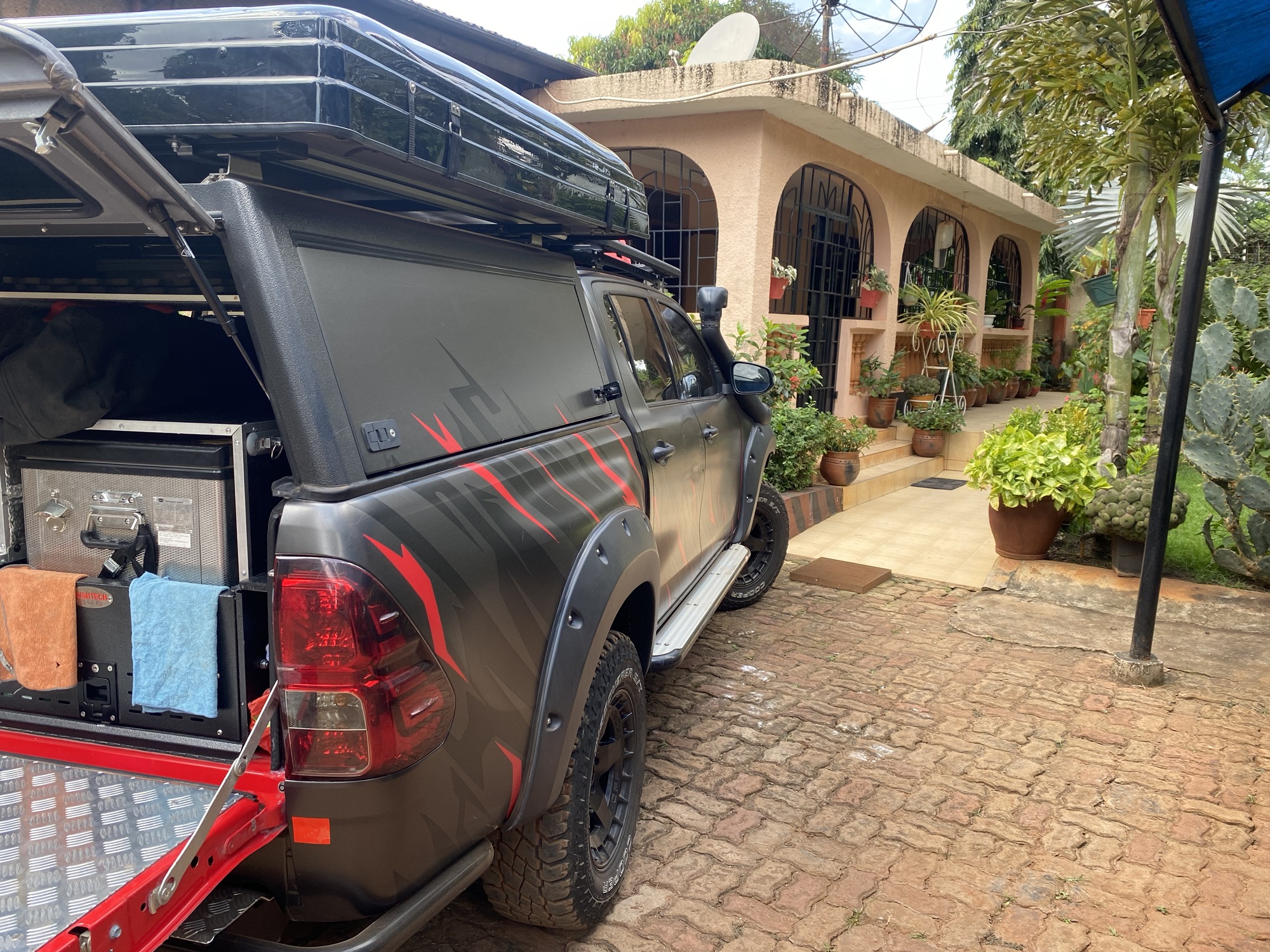
Quite a lot of work went into preparing the vehicle before shipping. There is already some info here concerning the vehicle build. Since it was going into a container, we loaded the vehicle with everything we needed, so we only had to take cabin baggage with us on the flight out to Namibia.
Shipping the vehicle
It takes 4-6 weeks to ship, so don’t leave it all to the last minute as you may well be disappointed. Start the enquiry process 3-4 months before you arrive at the destination.
For shipping a vehicle to Africa on a temporary basis, there are 3 main things you need to address:
1. Shipping: Container or roll-on roll off (RORO)? Due to the high value of the vehicle and its contents we opted for the more secure option of shipping in a 20ft container. This is more expensive than RORO. RORO involves lashing the vehicle to the deck of a dedicated vehicle transport ship. We have used this to permanently export vehicles to family living in Dar Es Salaam. If you pack any items in the car, I can 100% guarantee that they will get pilfered.
The door opening height on a container is 2.28m. You need to bear this in mind when building an overlander. Roof racks, suspension lifts and roof-top tents can easily send you over the height limit. I measured our truck and it came in at 2.25m, so we had only 3cm of clearance!
2. Carnet De Passage: This is basically a vehicle passport, enabling hassle-free temporary import of your vehicle to multiple countries. Goods are subject to import duty, so a hefty security deposit is left with the carnet-issuing authority to ensure you do not permanently import your vehicle into any of the countries you visit. Permanent import is possible, but is a different subject entirely and well beyond the scope of this post.
3. Freight forwarding agents at destination port: You may be able to negotiate this bureaucratic minefield yourself if you arrive in the country before your vehicle arrives, but it is much easier to get an agent to do all the customs clearing work for you.
Approximate costs of shipping from the UK to Walvis Bay, Namibia are as follows:
Container Shipping (20ft): £2224
Carnet: £6000 refundable deposit with additional £800 non-refundable carnet costs, so £6800 in total.
Port & agent fees on entry to Walvis Bay: £850
Documents required in order to ship the vehicle (digital copies are fine):
Vehicle MOT certificate, recently issued
Vehicle registration documents
Recent bank statement (proof of address)
Passports for all drivers
Driving Licences for all drivers
Bill of lading (shipping document issued by UK shipping agent on behalf of the shipping line)
Original documents needed to be sent via DHL to Freight forwarding agent (WFS) in Namibia:
Carnet de Passage
Vehicle Registration document
Digital documents required by Namibian freight forwarding agent. These are supplied by the agent, you just need to fill them in and return via email:
We arrived in Walvis Bay after a fairly long trip: 9 1/2 hours night flight from Frankfurt to Windhoek, arriving at 8am to a bright and very chilly Namibian morning, then spent the rest of the day transferring to Walvis Bay.
Points to note: You’ll need to know the name of a hotel in Namibia to fill out the Visa form correctly on landing. We had nothing booked, and the immigration official didn’t like being asked to suggest the name of a hotel we could stay at. The airport WiFi wasn’t working, so we couldn’t look one up. A fellow traveller helped us out by giving us ‘Roof of Africa’ hotel in Windhoek, which was where we headed to for some breakfast, and afterwards got picked up by our Swakopmund shuttle (Welwitschia).
Prices: Everything seems pretty cheap so far. £12 each for a 4 hour minibus ride, £40 per night for a swanky hotel room in the lagoon overlooking the beach, although the hot water ran out, and the electricity was intermittent.
First impressions: Everywhere is very clean, the people are very helpful. The towns are very modern; rather like South Africa but with a German feel (a legacy from decades of colonial rule).
The landscapes are vast and impressive on the 4-hour journey from Windhoek to Swakopmund, just a taste of things to come. Biltong and hot pies are widely available. Parts of Walvis Bay look a bit sketchy, especially the parts our taxi driver kept stopping off at to pick up and drop off more passengers.
Day 2
Next morning we woke up early, had breakfast and walked to the shipping office to collect the car. Flamingos are everywhere in the lagoon opposite the hotel. The car battery was flat – the air compressor had been left on during transport.
We stocked up on fuel, food and a warm blanket at the Dunes Mall. I had a rummage through Andy P’s suitcase, pilfered the good stuff and gave the rest to the Mall security guard. Again, people are very welcoming and friendly. We then headed SE towards Sossusvlei.
Just south of Walvis BayVogelfederberg Campsite near Walvis BayVogelfederberg Campsite – view from the rock outcrop
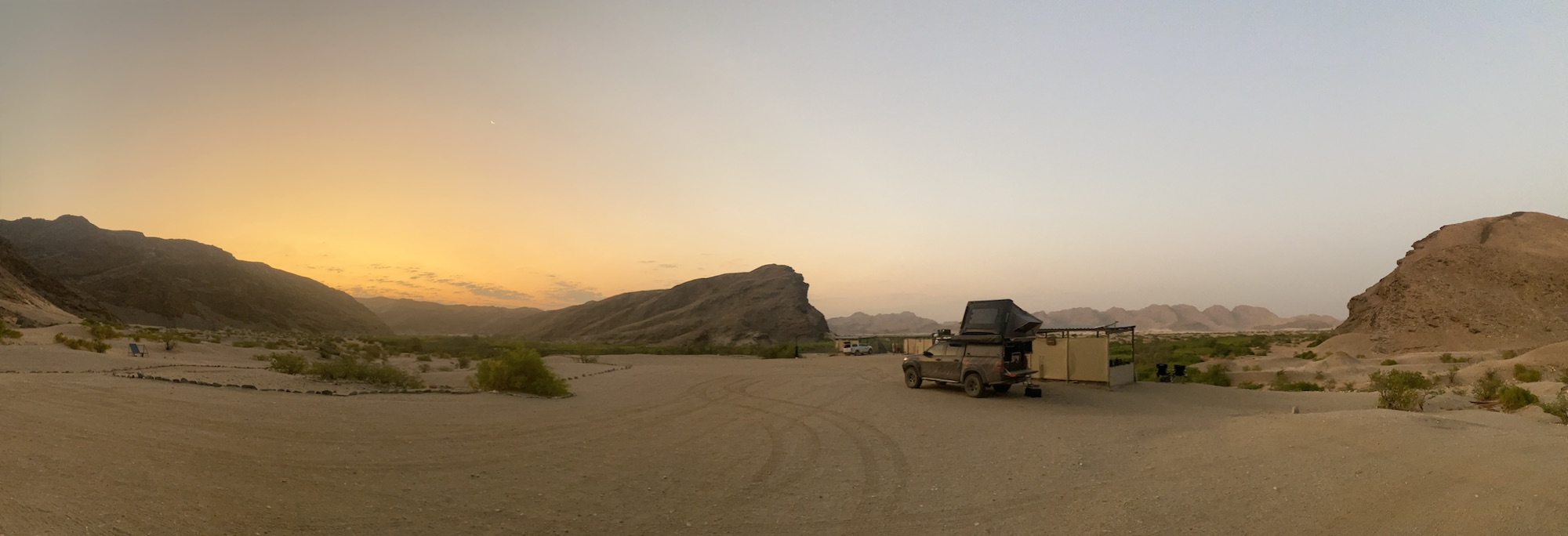
After a bit of a diversion towards the Kuiseb Canyon, we got back on the C14 and headed east through the Namib desert towards Sossusvlei. We stopped for a look at Vogelfederberg Campsite, just off the C14. Its very nice but has no facilities other than a long-drop toilet.
The scenery is stunning: vast, wide vistas, with a new view round every corner. As the sun was getting low, we started looking for a campsite. Kries se Rus looked good: far enough from the main road so to avoid being spotted: we didn’t have a camping permit – a bit of an oversight but we weren’t prepared to drive back to Walvis Bay at that hour.
The campsite was pretty wild, with no facilities. We had a small campfire, sunk a couple of bottles of wine and kicked back to gaze at the best view of the stars & Milky Way I’ve ever had. It was the start of June, so in the middle of the Southern Hemisphere summer: days pleasantly warm, evenings are cool and it gets pretty cold at night – the coldest part being just before sunrise. The thick quilt we purchased form the Dunes Mall made a difference, but we still had to cuddle close all night to stay warm.
Kries se Rus Campsite just before sunsetKries se Rus Campsite – Sunset looking over the Namib desert
Day 3
We packed up camp by 10am and continued towards Sesriem, stopping off for some photos of the Kuiseb Canyon and had lunch in Solitaire.
Views were spectacular again, even more so than the previous day. Cameras just don’t do this place justice. We spent all day on gravel roads, mostly they were in good condition with some mild corrugations in places. We were able to drive at around 60mph on the gravel, the roads being quite wide and straight. There was very little traffic compared to driving in other African countries, which made driving a real pleasure.
We did have to do a minor repair en route – the roof mounted solar panel shook loose so I gaffer taped it back on. I also noticed a couple of bolts securing the wheel arches were coming loose. A fairly simple fix. The MC4 solar connectors were loose too, so the solar panel wasn’t charging the leisure battery. I tightened them back up. I hope all repairs are this simple.
We stopped at a campsite outside the National Park gate in Sesriem – no point in paying double to camp inside the park to see the sunrise at Sossusvlei as we don’t get up early.
It has very nice views across the plains, with some bird life, Oryx, and at night Jackals and we also heard Hyenas. It is a great campsite: the fuel station and well-stocked shop are a lifeline for the local community and tourists alike, and the campsite pitches are far enough away and face out into the desert, so you get a wilderness feel.
Upper Kuiseb Canyon viewpoint Crossing the Tropic of Capricorn Lunch in SolitaireJust arrived at camp – Sosus Oasis in SesriemView from campsite across the Namib desertSosus Oasis campsite
Day 4
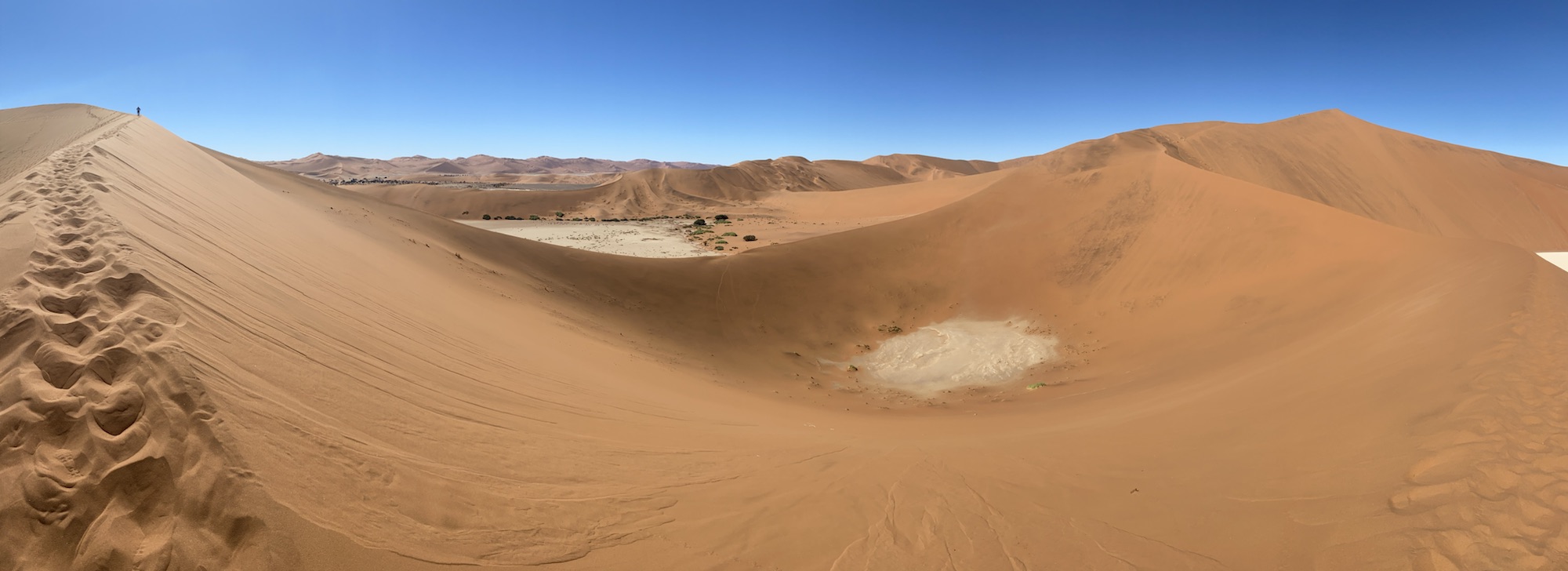
Sossusvlei and Deadvlei visit: The drive in was predictably spectacular, the last few kms were on a nice soft sand track which required a lot of throttle in 2nd gear 4WD. It was my first go at driving on soft sand and it was a lot of fun. At Deadvlei we walked up a giant bastard of a sand dune. I can see why people die within half a day of getting lost out here in the summer. Desert travel is much nicer from the inside a comfy 4×4.
Awesome views (again), but this time of giant dunes stretching far into the distance in all directions. The classic ‘Lawrence of Arabia’ type of view, minus the camels. The contrast between the red dunes and the cream-coloured pans make this seem like another world, and is why it gets lots of tourists visiting.
We have a light aircraft flight over the desert booked for the morning. It’s about £140 pp for an hour but we’re only here once I guess. Hot air balloon flights are £350 pp and the budget doesn’t stretch that far.
Returning to camp there was a bit of a cool breeze blowing. We didn’t bother lighting a camp fire – I just retreated into the shelter of the tent and cracked on with some work emails, then had an early night watching box-sets on the laptop.
Deadvlei PanDying on the climb – it is much steeper than it looks
Day 5
Doubling up the blankets during the night kept us nice and toasty, but it felt like the temperature didn’t drop too low. We woke to discover why: cloud and mist during the night had covered the skies, and there was the finest of light mizzle in the air (a made up word for ‘misty drizzle‘).
Our dune flight was cancelled due to the cloud cover.
Side note: Camping with the missus is often dampened by complaints of having to get dressed, get out of the tent and find somewhere suitable for a piss in the middle of the night. These complaints become more vocal when camping in areas with dangerous wildlife, using a roof top tent, or using campsites with long walks to the toilet blocks.
Bring forth the best camping gadget since the tent was invented: the she-wee. It allows the princess to have all the benefits of a gentleman’s sausage, but without the unsightly testes. Wee in a bottle, wee from the top of the tent ladder (spraying any camping equipment left in the way), the options are endless. It even gets round the problem of using rank ladies toilets. No longer ladies do you need to sit on a scummy throne. And it stores in a hygienic zip-loc bag too. It’s a game-changer: Suma now actually enjoys camping.
Good news: whilst writing the above, the weather began to clear up, so there was a chance the dune flight was back on again. We packed up and made our way to the lodge reception, and found that it was indeed back on! Our pilot outlined the route, we paid our £280 (bank card), and departed for the airstrip.
The flight was amazing: we circled around deadvlei and the dune we climbed the previous day, then headed directly west across the dune sea to the Atlantic Ocean. We flew north along the coast, around the area where The Grand Tour Namibia special was filmed. We then flew back inland across some more dunes.
It’s such a vast place, and well worth the money for a 1hour 10min flight. Suma did feel a bit air-sick halfway due to a bit of mild turbulence.
Afterwards we drove back towards Walvis bay, but now having a national park permit, we diverted off the main gravel highway towards a campsite in the Kuiseb river called Homeb.
The drive off the main gravel road was 50km across a desolate plain of nothingness, before dropping through a strange moonscape into a sand river, lined with tamarind-type trees and humming with bird-life.
The opposite bank of the river butts up against a wall of ancient petrified red dunes. They form the northernmost part of the Namib dune sea which we flew over earlier. The campsite is quiet and basic, and has only a water tap and a long-drop toilet that neither of us went anywhere near. Were happy to piss in the sand, the turds can wait for the posh bogs in the Walvis Bay mall resupply mission planned for tomorrow.
Desolate plain of nothingness, en route to Homeb CampsiteNear Homeb Campsite – camp is in the trees next to the dry riverTop ten fire – melting a wine bottle
Cheap community campsites like this are in beautiful spots but are very basic. This suits us fine as the truck has everything we need. There’s plenty of firewood available so it should be a good fire tonight. I’m skipping tea again due to being on a strict beer, whiskey & biltong diet.
Day 6
Another top day in the Nam. We had a morning stroll in the dusty riverbed and a friendly chat with a visiting voter registration official, who was armed with a pistol and rather bored that there were only 2 voters that he could register in the area. I resisted the urge to ask if i could shoot his pistol at some stuff, a decision I now regret as there may have been a chance he would’ve let me.
After sharing the breakfast leftovers with a couple of the most disease-ridden and ugliest dogs I’ve ever seen, we packed up and headed back across the nothingness back towards Walvis Bay.
Suma wanted a night with more luxury than our exquisite camping setup could offer, so we planned on a resupply then a hotel in Swakopmund that evening. The drive wasn’t that far, so we had the whole afternoon free. Work emails needed doing, but we had a leaflet offering coastal dune tours out of Walvis bay. When phone reception came available, I gave the guy a ring on the off-chance he had something available for that afternoon.
Result. We had just enough time for a turd-drop at the mall and then went to meet one of the guides at the lagoon (loads of flamingos there). A self-drive was not possible due to our truck being so heavily-laden and top-heavy with camping gear: lack of local knowledge and experience meant we would have either got stuck in the dunes or lost the car in the Atlantic Ocean.
We played it safe and opted for a ride in a 100 series Land Cruiser with our own expert driver.
We then had a 4 hour trip: starting off heading south down the beach dodging waves, then returning via the dunes with a lunch/beer stop.
It was superb. The driver was so knowledgeable and had years of experience playing in the dunes. It was amazing fun, and I’d recommend it to everyone. It was even better than the dune flight and most definitely one of the many highlights of my years of travelling.
Lovely sunset on the coast road near Swakopmund
That evening we went to a bar/restaurant, I ate a fantastic steak while Suma grazed on some salad. We had a few drinks then headed back to the hotel for an early night, knowing tomorrow we had to crack on with our journey. Almost a week had passed with us pissing about having enormous fun in the desert, and we were still no closer to Tanzania.
Day 7
We had an early start to drink some coffee and do some overdue work emails, then a food/fuel resupply that we put off from yesterday in favour of the dune trip.
We knew we wanted to head north, but hadn’t got a route planned due to conflicting opinions from people we had been speaking to.
So we just headed north along the salt road towards Henties Bay, briefly stopping to look at a shipwreck, one of hundreds along this coast. Often the roads in Africa are lined with people selling local produce: mostly food like bananas, sugar cane, tomatoes etc. In Namibia, the locals also sell local produce at the roadside. Since no food will grow in a desert, they sell rocks and minerals.
At Henties Bay we turned inland towards Uis, the scenery pretty bare and bleak.
Just after Uis, there was a signposted turn towards Twyfelfontein. There were more people in this area than in the desert: a lot of topless Himba women trying to flag the car down.
This area showed on the map as being a UNESCO world heritage site, so we decided to head towards there as it was en-route to the Hoanib valley and Epupa falls.
The scenery began to change into looking more African: red sand/dirt roads, lovely small rocky mounds and short shrubs everywhere. Very pretty and great fun to drive through.
At Twyfelfontein we topped up on fuel at a bush fuel station, and when I asked, the attendant assured me there was no water or elephant shit in the diesel.
After paying the chap, we realised that we were pretty low on SA rand / Namibian dollars: nowhere near enough to pay for fuel and camping through the remote northern part of Namibia we were headed next. A bit of an oversight! Looking at the map (and Google – we had phone signal), the only place guaranteed to have an ATM was at Khoriaxas, a village 50 miles away but in the wrong direction for us.
Being in such a remote area we had to play it safe and divert to the ATM to stock up on dollars.
So here I am, now sitting at a reasonable stopover campsite just outside of the village, with a wallet busting with a brick of Namib dollars, sipping an ice-cold whiskey & coke.
It was a long drive today: 7 hours on mostly gravel roads. Some bits were smooth, other parts had corrugations that loosen the tooth fillings. We stopped only occasionally to check the vehicle. Nothing had worked loose. That last 50km into town was a grueller. The truck worked hard today, it performed brilliantly.
I didn’t take any photos today as we were just mile-munching.
After waking up early we left the nondescript NWR campsite in Khoriaxas around 9.30am for another day of driving. We were headed another 200 miles north to see the famous desert elephants in the Hoanib valley.
The drive was stunning, again. It was mostly driving along flat plains surrounded by low mountains. The first area were all flat-topped mountains similar to those in Cape Town.
The next area after the small settlement of Palmwag the mountains were more rounded. We were told that there was no fuel ahead in Sesfontein so we topped up the main tank and for the first time filled the 2 x 20l Jerry cans that were mounted on the roof rack. With the long range tank full we now had 180 litres of fuel, 70 litres of water, loads of booze and food.
We passed through Sesfontein and headed through 10 miles of easy sand tracks to the entrance gate, behind which was perched a campsite overlooking the plains. We had to wait a while due to a family of elephants drinking from a waterhole in the riverbed, blocking our route to the campsite.
Plains near HoanibElephants in the river-bed
The campsite is called Elephant Song. It is fantastic and in a superb position, the views are great. Each pitch has its own toilet & kitchen block and a shaded porch overlooking the plains. 580 NAD per night for camping and 450 NAD for 2 days in the valley. Roughly £50 so not exactly cheap, but what a view! It’s the best campsite of the trip so far, and has made it into my top 5 campsites ever. The one at Sesriem takes some beating, but this is better.
View from Elephant Song campsiteSunset at campWe had our own porch and shower block
Day 9
An early start again, just a cup of coffee for breakfast and we were greeted by a lovely sunrise…
Sunrise
We had another big day planned: a short-ish drive down the Hoanib then a big drive north in the direction of Epupa falls on the Angolan border.
We had a good long chat with a fellow camper Rowan, who has travelled extensively all over Southern Africa and gave us some great tips about our route onward through Namibia, Botswana, and Zambia. I already had a rough route planned and lots of areas with unanswered questions – he was able to give the route a fine tune based on his experiences. We may well catch up with him in a few days in Ruacana.
The Hoanib drive was great. You can follow this route all the way to the skeleton coast if you want, but we were on a limited timescale so just a quick in and out would have to suffice. More time was needed in this area – a recurring theme on our trip. The trail was a mix of gravel and alternating hard-packed & soft sand. Second gear high range 4WD kept us plugging through it with no problems, although I had to watch out for the patches of softer sand that needed some extra throttle to gun it through.
We did stop to let more air out of the tyres: they were at 25psi so I dropped them down to 17psi. It may have helped, but a downside was lower ground clearance. I could feel the front bash plate acting as a sand-plough and slowing us down in the deeper rutted sections. Speed and power wins the day, and we didn’t get stuck whilst using this mantra.
I noticed a 4WD trail on the map leading up a side valley that went all the way to the Purros road. Taking this would give us a nice 50km loop back to Sesfontein. It looked well used, so we took it and had a great time on the sand trails.
Suma spotted some giraffe under a shade tree ahead of us so we slowed down, expecting them to bugger off as per usual. But they didn’t sprint away, so we managed to get a couple of nice photos before leaving them be. We didn’t see any other wildlife on that morning drive, but there were plenty of signs of elephants.
Hoanib valley drive
The Purros road was in bad shape: very rocky and slow going: the sand was faster, more fun and easier on the vehicle. After a failed half-arsed attempt to find some hot springs near Sesfontein we headed north on the long gravel road to Opuwo. We reached there around teatime, surprised that it is quite a large town.
There are a lot of topless Himba women here wearing their really cool traditional dress. Nice to see them going about their business and not trying to flag down foreign travellers to perform for. We stocked up on fuel and snacks at the local Spar, but instantly got mobbed by loads of kids begging for money and food. Not what I wanted after a long drive. I gave a couple of them 10 NAD (about 50p) when they came good on their promise to look after the car while I was in the shop. I was parked next to a truck full of policemen, but it never hurts to double up on protection.
Suma found Kaoko Mopane lodge / campsite just outside of town so we stayed there. It’s fine as a stopover. It has better facilities than the previous night camp and a very nice view across a dry river bed. Fuel-wise we are using around 50 litres per day.
There have been no major issues with the truck, but a couple of niggles with the camper conversion. The main one being dust finding it’s way into the rear canopy, covering everything. Our clothes are in sealed ammo-boxes, the food is all tucked away in the fridge and drawers, so it’s not a major issue. The fridge thermostat is also acting up, but the food & drinks are staying cold, just -5 to +5 degrees C.
It’s feeling more like an expedition than a holiday. Good stuff.
Day 10
We had quite a relaxed and slow drive north from Opuwo to Epupa, the road being all smooth gravel with countless dry stream & river bed crossings that we had to crawl through in 2nd gear.
There were loads of traditional Himba villages along the route. Two ladies flagged us down at the side of the road so we stopped. The older one wanted a lift to Epupa, so we obliged. The younger one was wearing traditional dress and kindly allowed us to take her photo.
Arriving at Epupa we had a look at a couple of campsites and settled for a stunning campsite with pool, raised bar and a riverside pitch, all for the princely sum of about £8 each per night. This afternoon I’ll be mostly sitting by the river sipping cold Windhoeks, doing sweet FA.
View from our pitch. Baby croc on the log None of these photos show how spectacular the falls are.Epupa falls viewpoint
Day 11
A lazy start to the day, doing work emails and chatting with other campers. We then headed for Ruacana, hoping to find a nice riverside campsite near there.
The road was quite rough and slow going: mostly 3rd gear with plenty of second or first gear rocky or sandy river crossings. A few times we went into low range.
Kunene river looking across into Angola
The drive was quite fun with occasional views of the river and across into Angola. There were very few signs of human activity over the border, it was deserted. The Namibian side was more populated. Lots of Himba settlements, cow and goat herds. Always there were small children holding out their hands begging for food and money. It seem like a habit they learn from a very young age.
The lifestyle out here has changed little in thousands of years. The Himba are semi-nomadic: growing crops in the wet season and rearing livestock in the dry season. They all look healthy, and so do their livestock.
We tried a few campsites along the riverbank, but none were anywhere near as nice as the ones at Epupa falls. We have become a bit spoiled with spectacular campsites.
I turned the car into a tree while reversing. Bummer, the dent in the door will pull out easy but the wrap is damaged. Easy fix for a later date.
After failing to find a suitable site, we pushed on to Ruacana, finding the EHA lodge & campsite near the town centre. It was getting close to teatime: they had a bar and a functioning restaurant so we decided to stay there. It was quite posh being a service hotel for the nearby power station. My steak was great, my first decent meal since the last steak in Swakopmund.
Day 12 – Olifantrus campsite
There was a bit of a faff in the morning, after re-inflating the tyres for the smooth tar road ahead. I lost a tyre pressure management sensor that I had left on the rear tyre and then drove off, burying it forever in the sand.
Fortunately the system still works without constant beeping from the missing one.
The drive from Ruacana to the western Etosha National Park gate was lovely smooth asphalt, so we quickly smashed through the 300km distance. No roadside begging kids to be seen. Just loads of sheep and cow herds crossing the roads. Even on the tar, you can’t drift off into a daydream. But it was a nice break from almost 2 weeks of constant corrugated gravel, rocks and sand.
Entering the western gate we wanted to stay at the new Oliphantrus campsite about 70km inside the park. Since booking ahead requires too much effort, I asked about availability at the new campsite at the gate (as per the advice from other travellers). The lady at the desk was very unhelpful, and could only tell me the distance to the camp. Her colleague on a different desk was far more helpful: he phoned ahead to the camp, confirmed there was space for us and sent us merrily on our way.
As we are more used to the hugely expensive Tanzanian Parks ($75 USD pppd + campsite fees) I was chuffed to pay only $1050 NAD, approx. £40 GBP for 3 days & nights for 2 people!
On the drive to camp we stopped at a couple of waterholes and saw the following:
Elephant, Greater Kudu, Blue wildebeest, Red Hartebeest, Southern Giraffe, Plains zebra, Mountain Zebra, Springbok, Vulture, Black faced jackal, Ostrich, Oryx.
The park is very flat in the western part with mostly short, parched, widely spaced trees and some more open plains.
The camp is fenced, keeping the wildlife out and the missus happy. There is a waterhole with raised wooden hide/viewpoint. Zebra are skittish but they come close, scampering away at the sound of the camera shutter. Its the closest I’ve been to Zebra. It’s very nice here.
Walkway to the waterhole- Olifantrus sunsetSunrise from the tentOlifantrus sunsetOlifantrus campsite sunrise
Day 13 – Halali campsite
We had a 170km drive across Etosha ahead of us. From west to east heading to Halali camp.
En route we passed an enormous waterhole with far more animals than you could count, then a large zebra herd marched in, well over 100. There was loads of activity: Jackals hunting small birds, Springbok fighting, Oryx fighting, zebra squabbling and jostling for position around the waterhole, Wildebeest too. Plenty going on and all very entertaining.
The roads in Etosha are in terrible condition. With the amount of revenue coming into the park they could surely afford to send a grading machine around to smooth out the corrugations.
We then headed to Okakuwejo for lunch. It’s more of a town than a campsite. It caters for large groups and was fully booked. Continuing on, the road was very corrugated, so we just blasted across the washboard, reaching Halali camp at 3pm but pretty tired.
The camp waterhole was really nice, there were some elephants when I had a look in. I had a beer and a nap.
A few people had reported Rhino sightings in the area, so I was keen to get back out. I booked a night time game drive (3 hours for £30). The nights are cold and the game vehicles are open. 3 T-shirts and my only 2 hoodies just about kept me warm. The game drive was a bit disappointing. A brief glimpse of a distant Hyena and some snoozing lions. No rhino unfortunately. The lions did break out into some load roaring which was very impressive.
Halali campsite does seem to be the best for wildlife at the waterhole. Rhino are regularly spotted there. In fact, they were seen around the waterhole while I was out on the game drive specifically looking for them.
Halali campsite waterhole viewpointEtosha Pan
Day 14 – Namutoni campsite
Next day I was determined to spot a rhino, so we spent all day winding around the roads, re-checking the same water holes over and again. But without success. There were plenty of other animals, but no rhino.
Namutoni camp was our next stop, on the far west of the park. The park is approx 320km wide. We arrived at camp pretty tired again after a long day of driving. Suma had read that the camp was built around an old German fortress. And the Germans didn’t let us down. The fort has amazing 360 degree views across the whole area. The plain and Etosha Pan are flat, so from atop the 100ft battlements you can see for many miles in every direction. There are a number of natural waterholes surrounding 2 sides of the camp.
View of the perimeter fence from the fort tower
You can also walk the perimeter of the campsite, they have left a good margin of dense bush separating the fence from the site. Walking the perimeter past the waterholes and through the bush feels as close as you can get to walking in the wild African bush.
After a wash and some beers we will walk the perimeter again when it’s dark. Its a half moon tonight so we won’t need a torch.
I took a walk by myself around the perimeter in full darkness. Its a unique experience. You find yourself wondering how lion-proof the enormous electric fence is, and come to fully understand your place in the food-chain in this environment.
I spooked some giraffe who heard me approaching long before I saw them. We went back to the waterhole later on and there was a lone bull elephant, and 2 spotted hyenas skulking along in the distance.
Rant time…
I chatted to a Namibian guy on the neighbouring pitch on the campsite, and he said they lost 18 Rhino from Etosha in the last year to poachers. This is entirely due to massive demand from the Chinese herbal medicine market. For such a technologically advanced society (world leaders in EV’s for instance) to still believe in such utter bullshit astonishes me.
I did a quick google search to find out why they like Rhino horn. It has very many completely made-up health benefits. In 2018 the Chinese government reversed a ban on Rhino horn being used. Like the Japanese and their Whaling fleet, this is allowed to continue under the guise of ‘scientific research’. Words fail me.
Understandably, the Chinese are not popular in Namibia. When Namibians talk about Chinese, they lead with: “I’m not being racist, but…’
Chill out day in camp in Etosha as we both needed a break from the constant driving. I did some minor checks and repairs to car, some work emails etc
View from the tower at the repurposed old German Fortress at Namutoni CampsiteSpectacular sunsets in Namutoni, 360 degree views of the pan and surrounding flat terrain
Day 16
A big driving day from Etosha eastern gate, over to Ngepi campsite on the banks of the Kavango river (just as the river diverts south into Botswana to form the world famous Okavango Delta).
We arrived in camp late: just before sunset. I would have liked to have been here earlier to enjoy the river view more. The campsite is lovely: a riverside pitch, and loads of character to the site.
The shower blocks are pretty funky: open-air with reed privacy screens and jungle plants growing around you. For those of you old enough to remember, it feels like the Aztec Zone on the Crystal Maze. There are Hippos in the river in front of us, grunting loudly and flicking turds around as is their way. Another top campsite in Namibia!
We sat around the campfire drinking Vodka & tonic, chatting and listening to the wildlife. There was plenty going on. Hippos all night, although none came through camp. We also heard loud trumpeting Elephants, far off in the distance.
This camp is sat opposite the Buffalo Core area, adjacent to the Mahango Core area of Bwabwata National Park. It’s a transit region for animals crossing from Zambia, Angola, Botswana and Zimbabwe.
Day 17 – Along the Caprivi strip
The temperature dropped fairly cold again last night, although it didn’t drop as low or as quickly as in Etosha. Suma got spooned across the tent again.
We awoke early to a noisy chorus of birdsong. This area is a birders paradise.
The week ahead will see us going deeper into this lush region of rivers, swamps and abundant wildlife. I expect we will be paying a lot more than £20 per night when we reach Botswana!
Ngepi camp view at sunrise, Kavango river
We drove around the Buffalo Core area in the morning (£10 entry, also covers Kwando core area, which we didn’t see but would be spectacular).
We saw: Elephant, Buffalo, Kudu, Impala, a tiny antelope species yet to be identified, vervet and warthog. Also for the first time ever, a large Sable Antelope.
Leaving the Buffalo Core area, I forgot to close the side door on the rear canopy, so we lost some stuff and had to backtrack 20 miles to retrieve it. We found the expensive MSR cookset at the roadside but lost some plastic cups. Could have been a lot worse!
It was around 180 km of straight fairly boring driving on tar roads to our next stop along the Caprivi strip. The environment was mostly thin forest, with a diversity of tree species we just don’t see in Europe. There were a lot of traditional villages either side of the road; very neat circular huts precisely made from wood & thatch, enclosed by a wooden fence to keep the wildlife out.
We paid 250 NAD (£10) for a campsite in Mudumu game reserve on the banks of the Kwando river. Weaving our way through deep sand tracks to our remote riverside pitch, there were many signs of Elephants.
When we arrived at the first campsite there were 2 families of Elephants out in the river in front of us. It was stunning. Wilderness at its best.
There were no toilets, washing or shower facilities though. Suma didn’t like how remote it was and how vulnerable we were to wildlife. She put her foot down, I sulked and we drove out to find another campsite.
We found Livingstone campsite about half an hour down the road, just outside Nkasa Rupara NP. It’s more expensive at £37 per night for the pitch. There are proper toilets & showers etc, the pitches are enormous and secluded.
It is still unfenced, and still in a wildlife area so you can’t piss about walking off into the bush at night or go for a morning jog (not like I would).
The camp is in the Linyati swamp area, a stones throw from the famous Chobe / Savuti area of Botswana. It’s dry right now, so no swamp.
So far, it’s quiet: I saw some baboons and warthog earlier out on the dry plains but we will see what the evening brings. We heard distant Lions roaring.
Sunset view over the dry Linyanti swamp from Livingstone Camp
Day 18 – Crossing to Botswana
Today was border crossing to Botswana at Ngoma Bridge. It was really easy, we were through in 45 minutes. It would have been a lot longer if we hadn’t have just got in front of a coach load of Tunisian tourists. Unusually there were no ATM’s, SIM card sellers or currency exchange at the border.
At the first fuel station we topped up the tank. Their card machine wasn’t working but they accepted USD. The only rub was the tragic exchange rate: we paid $80 USD for 40 liters of diesel.
We needed money, phone SIMs and food so we had to head to Kasane, 50km away in the wrong direction for us. Unlike Namibian supermarkets, there were no hoards of beggars hassling us outside. Botswana is quite a rich country.
We looked in at the Chobe Safari Lodge, but they had no available camp pitches. It was heaving with high-end tourists. After almost 3 weeks of living feral, being surrounded by 5 star luxury felt wrong, so I happily drove off to the next campsite.
It was pretty nice. Everything in Botswana so far has been twice the price of the Namibian equivalent. So far it hasn’t been twice as good, but we will see what the next few days bring.
The campsite owner told us that our planned ‘4 hour sand track amble’ to Khwai was more like a 9 hour grueller, and that the Savuti campsite at the halfway point would be fully booked. People visiting Botswana usually have to book campsites at least 12-18 months in advance. Booking ahead doesn’t fit with our travel style.
Our plan had changed: we were to head to Khwai the long way round via Nata & Maun.
The campsite owner advised us to do a river drive down towards Kasane – the region is in the middle of a drought so the game has all been forced north onto the banks of the Chobe River.
Day 19 – Chobe NP & Ihaha camp
We took the camp owners advice and had a fantastic morning game drive through Chobe NP, exploring along the riverbank and the sandy hinterland tracks.
There’s loads of game around: all the usual suspects. There are lions here but we couldn’t find them.
At lunchtime we stopped in at Ihaha camp along the river bank, on the off-chance that they had a camp pitch available for the night. Result! They did. We just had to drive down to the pitch to make sure it was up to the princesses high standards.
This camp is unfenced and next to the river in an area with lots of game, including several lion prides. We chatted to a South African chap a few pitches down from ours, who assured Suma that everything would be fine, provided you follow the normal fairly basic common-sense night-time rules: don’t wander off, drive to the toilets, and close your feckin tent! Hearing advice from a such a knowledgeable & seasoned traveller helped put Sumas mind at rest. Ihaha has a reputation for night-time thievery from Namibians crossing over the river, so we will be locking up all our shit.
Our Afrikaaner friend also gave us some great advice about Savuti and Khwai – he had just been there a few days previously. He said the sites will likely be booked, but just turn up anyway. People booking so far in advance often change their minds and don’t cancel, leaving lots of emptying pitches at otherwise fully booked sites. They have spare pitches that they leave for emergencies, so they will always find room for you if you ask nicely.
And so the sand road route to Khwai is back on. So far I’m really liking driving on sand. It’s usually nice and soft, not corrugated but rutted, and you need some power to get through it.
So here we are sitting looking out over the dry plains, with several large herds of buffalo snoozing and grazing the plains opposite. Also in the far distance is a huge herd of Zebra. The views are great. We were told there were lions passing through last night and this morning, and I can see a single set of lion prints in the sand running through our pitch.
We were treated to a stunning sunset. The 2 large herds of Buffalo merged together, there’s an Elephant about 150m away, various birds and a few baboons mooching around. It’s very peaceful & quiet. Time to start the fire and kick back with a vodka & tonic.
Another fantastic camp spot. Ihaha is blessed with both stunning views and abundant wildlife.
Following the Chobe riverSunset Ihaha campSunset Ihaha campSunset Ihaha campSunset Ihaha campLion pug mark in Ihaha camp pitch
Day 20 – Savuti Camp Chobe NP
Big long sand drive today. We left Ihaha early and headed to Kasane to stock up and contact family. My boy Josh turned 13 today but we didn’t get in range of a phone mast in time to wish him happy birthday before he went to school.
After stocking up we headed back along the slow boring road from Kasane to Ngoma again, then turned towards the dirt road south west towards Maun: almost 300km of rutted 2-spoor sand tracks lay ahead, with a stop off halfway in Savuti Camp planned. We were stocked up with 180 litres of diesel again.
The sand road was fine. It was quite rutted and had some occasional hard corrugations, with some softer parts that needed 2nd gear and plenty of throttle to get through. I only had to put it in low range once when I went past a turn off and got a bit crossed up in the sand ruts.
We hadn’t booked a camp in Savuti, at the Northern Goha gate we were told that the camp was fully booked (as expected). They also mentioned that if we asked nicely they may let us stay on one of their reserve pitches.
We arrived in camp around 2pm, and the friendly staff were good enough to let us stay on one of the reserve pitches. It was close to the ablutions block, built like a WW2 bunker to keep the elephants from destroying everything in their search for water.
The pitch was large and sandy. In the UK we would build 10 houses on land this size.
After a quick drink and rest we headed back out for an afternoon game drive. There was plenty of action at the waterhole, which we kept circling back towards after exploring some sand loop tracks.
Suma kept disturbing the waterhole quietness by loudly giggling at a Buffalo with the worlds’ largest testicles.
The camp gates close at sundown so we headed back with enough time for a shower before it got dark. Being unfenced and near a waterhole meant we had to stay close to the tent again. We felt less vulnerable on the reserve pitch as it was right in the centre of camp.
We heard Lions and Elephant all through the evening, the sound coming from the direction of the nearby waterhole.
Day 21 – Savuti to Khwai
We agreed a price of $50 USD with a guide to sit in our car and try to lead us to either the Marsh Pride or the Northern Pride. Both prides are made famous by regular appearances on Discovery Channel.
We drove around for 4 1/2 hours but unfortunately didn’t see any Lions. The scenery was lovely, and we saw plenty of other animals.
We dropped our guide back at Savuti camp and headed south towards Mababe gate on the Marsh Road. This is not drivable in the wet season but is fine in the dry – baked hard rutted grey trails.
It was a very long day driving today, all the miles were either sand or dirt: deeply rutted, twisty and very pleasant for most of it. There was no wildlife in the 60km from Savuti south as there is no water. Approaching Mabebe gate the wildlife density increased as there was a waterhole nearby.
We checked the Garmin and Magoltho camp came up. I recognised the name from some YouTube videos I had watched, so we set course for there, only 13km away. We were both pretty worn out after 7 hours of constant off-road driving, so the last stretch felt a bit arduous. The gravel road section was in terrible shape. And the last push to camp was like a full on sand trail game drive going further into the bush: elephants blocking the way, deep sand etc.
We eventually came across the campsite, it was spread out over a large area and it took a while to find reception. It is a community camp, where we have found if you substitute the word ‘community’ for ‘shit toilets’, you’ll have a better idea of what to expect.
Again, since we hadn’t booked in advance, and it was getting close to sunset, I turned on the charm to see if they would let us stay for the night.
It turns out that being polite to people in Botswana can curry many a favour.
Despite the shit toilets and cold showers (which Suma strongly disapproved of) the camp is one of a kind, and if you can blag a pitch here it is so worth it.
On our pitch there were a family of elephants munching the perimeter trees when we arrived. They ignored us as we cooked tea (veggies for Suma and a peasant/student meal for me: noodles & corned beef).
Magoltho camp, zebra & impala on the grass
We were told lions had been spotted along the riverbank, heading in our direction. We neither saw nor heard them for the rest of the evening, although we made sure the camp fire was impressively big: there were a couple of part-burnt huge logs which we finished off. There were plenty of Zebra hanging around all evening.
We saw a very impressive full moon rise just after sunset. It was spectacular.
The lack of hot showers at Magoltho and recent fairly long stint in the bush prompted us to head down to Maun for a bit of R&R and to get some overdue chores done (work emails, car oil change and clothes washing). We would then head back up to Khwai.
The drive to Maun was down a really badly-maintained gravel road, with patches of sand, ruts and dips all thrown in. It was fairly slow going, the car rattling along at 50kmh on the faster stretches. Nowhere near as fun and interesting as the Ngoma to Magabe sand track. We got into Maun by lunchtime, stopping for a delicious steak just north of Maun, and stocking up at Shoprite.
We headed for Sitatunga campsite, recommended by the Youtuber Edward Bath. The site is fantastic. Decent-sized pitches, excellent private ablutions (which we paid a little extra for – 200 Pula per night total v 160 Pula per night for the pitch with shared toilets).
They have a bar, restaurant, WiFi, and even an on-site mechanic. The staff and visitors are all really friendly (something we had been experiencing everywhere on our trip so far). It has a really nice feel to the place. When heading over to the bar, it must have taken us over 40 minutes to get there – people stopping us to say hi, have a chat and swap notes on where each other have been. We made friends with a very likeable young couple from Cape Town. The site (as with all campsites in Botswana) is full of convoys of South Africans towing luxury off-road caravans filled with meat, beer and biltong (beef jerky in the UK). These guys know how to camp in style!
With this fairly rough and remote part of Botswana (and even more so in Namibia), fellow travellers are always happy to swap notes on road conditions, good campsites etc. We have been getting some great up-to-date knowledge passed to us from people heading from where we were going. This information really helps in making decisions on route planning, even giving reassurance on stretches of road that you may previously think undriveable.
Day 23 – Chill out in Maun
We needed to get the engine oil changed, and the campsite mechanic offered to do it for me. I just had to pop into town to get the parts needed. He then spent a good few hours trying to get the old oil filter off. It had seized on pretty well, and he didn’t have the correct socket-type tool to remove it. I got some work emails done, using the campsite WiFi. The BTC SIM-card & data plan we had purchased in Kasane upon arrival was totally useless.
Day 24 – Hippo Pools Campsite near Khwai
After saying farewell to our new mates, we resupplied with food, booze and fuel in Maun. We left town at 10.10am, which is 10 minutes after the liquor store opens. The drive north on the shit road back up to Khwai was the same car-shaking corrugated cack that we had on the way down. Approaching the road feeling fresher meant that it didnt feel as bad as before. I have noticed this a few times now; if im really tired after a long days drive, then finding a badly corrugated road as the final stretch wears my patience. It becomes a bit arduous.
After getting through the 3 or so hours of endless corrugations we were in the Khwai area, not far from Magoltho campsite. The iOverlander app on the Garmin showed a couple of campsites nearby, so we stopped in at Mbudi campsite on the river of the same name (which flows into or out of the Khwai). Rivers in the Okavango Delta seem to flow backwards. The big Okavango flows in, then splits into a delta, fanning out over large flat area. It never reaches the sea.
At Mbudi, our pleas with the guy to let us stay by the river were met with the usual happy helpfulness. He found us a pitch, which wasnt really a pitch but was just in a bush clearing next to the river. Perfect. His boss came by shortly afterwards and told us we couldnt stay there, gave us our money back and we left. He explained that both he and us would be fined if the government found us camping in the bush around here. Understandable, but i felt bad for the kind fellow who originally helped us, as he had a right bollocking from his boss. Mbudi looks to be an amazing campsite.
We had chatted to an Afrikaaner we had met at Sitatunga the previous day. He was staying here for 3 nights and not going into the Moremi Game Reserve – in his valued opinion, the Khwai area is better as it is wilder. He had seen a Leopard on the drive into camp. It seems to be a recurring theme, us being somewhere where there was something cool seen just hours previously. Such is the nature of the wild.
We left Mbudi and looked for the next campsite on our list: Hippo Pools. The satnav wanted to take us on an odd route there. We had plenty of time so we took it, to see where it went. It turned out to be quite a nice game drive, with a close encounter with a family of Elephants. The whole area is criss-crossed with bush roads, so you could spend weeks here.
When we eventually found Hippo Pools campsite (it is a short drive from Khwai Village), we were delighted to find they had a pitch available beside the Khwai River. Awesome. We had plenty of time to set up camp and lounge around. There were a few Elephants drinking, Buffalo and true to the campsites name – Hippos.
We were very close to the river, and those Hippos like to leave the river at night and graze. Hippos are extremely dangerous, being responsible for more human deaths than all the other animals combined (average over 500 deaths per year). They are permanently grumpy, and charge with no warning. They can run faster than a Jamaican sprinter, and command the utmost respect.
I discussed with Suma what we would do if faced with a Hippo. Since we would be close to the (unlocked) car, then we would run to the opposite side and jump inside as quick as possible. If that wasnt an option, then we would run around one of the wide trees or bushes that we picked out as being fairly sturdy. The logic being that while I might not be able to outrun it, I might just be able to dodge it long enough until it got bored.
We lit the customary fire then kicked back and relaxed. When it was pitch black we could hear something eating grass nearby. I scanned in front of us with the torch, but couldn’t see anything. Our neighbours, about 50m away, must have seen something silhouetted against our fire. They pointed their torch in our direction, and it illuminated an enormous Hippo, casually grazing just a 5 metres from us. We both jumped out of our seats, and prepared to leg it in the direction of the car. The Hippo just carried on eating grass, and slowly ambled back towards the river, so we sat back down.
We kept a more vigilant watch from then on. The Hippo went downstream for a few metres, got out of the river and reappeared behind the car, just next to the tailgate. We watched as he ambled off into the thick bush and disappeared. Not knowing if he would reappear directly behind us, we decided to finish our drinks and head to bed.
A hippo circled our camp after dark
It really is a beautuful area here. Unlike many Botswana rivers, the Khwai river is not seasonal. It has water in it year round. As a result, the area is a lot more lush and green than elsewhere in the parched Kalahari. The trees grow taller, and it just looks more like paradise. Permanent water means abundant wildlife, and is the reason why the Okavango Delta is a world-famous safari destination. We don’t have the funds to visit the luxury camps inside the delta that are only accessible by light aircraft.
Day 25 – Long drive towards Makgadikgadi Pans
We left Hippo Pools and entered the Moremi Game Reserve at North Gate. We drove around for a bit, enjoying the lovely scenery. The decision was made to head out to Khubu due to time constraints, so we diverted to South Gate down a dull Mopane-lined road then back onto the shit road to Maun, stopping for a delicious steak at a restaurant.
Random Lake in Moremi
We had a dull drive south-east towards Camelthorn Campsite. The gates were locked, the buzzer was disconnected & we couldnt ring them due to our shit SIM cards. So we headed to next campsite – Boteti River Camp. They had no pitches available but wanted $90 USD for a small canvas tent.
We moved onto the community campsite inside the MK NP, which turned out to be more far more expensive, and based on previous experience, probably a bit shite. So we bit the bullet and went back to option 2 and forked out $90 USD for a bed in a canvas tent at Boteti River Camp. It was nice for a stopover, despite the very high price. The Boteti River does not flow in the dry season.
Day 26 – Khubu Island
I had heard that getting to the very remote Khubu Island could be a bit of a mission, so we checked with the campsite manager as to the best route in. Both he, and an Afrikaaner family who had just come from there, advised us to head in from the south as it was a short way in, and a fairly easy track. The way out north back towards Nata would be fine too. They advised that other tracks in the area were in terrible shape and should be avoided. I reciprocated with some advice on their proposed route north through Moremi, Savuti and Chobe.
On the way we saw a sign to the Central Kalahari Game Reserve 45km down a side road, so we gave it a try. After a couple of km it turned into a deeply rutted sand track, full of holes and about 6″ deep of fine powder which exploded into huge clouds when driven through. It was really slow going, and although the car would handle it, I didn’t really fancy plowing through another 40km of it, risking it filling up my air filter and potentially damaging the engine. We hadn’t planned on visiting the CKGR anyway, so we turned around and went back to the original plan: Lekhubu Island.
The drive in was fine; sandy & twisty, the track splitting into multiple routes in places. You for sure need a satnav here to keep you heading on the correct bearing. After a while going through dense stunted Mopane, it opens out for the last stretch onto some lovely pans. The trail crosses and skirts them. Its very pretty.
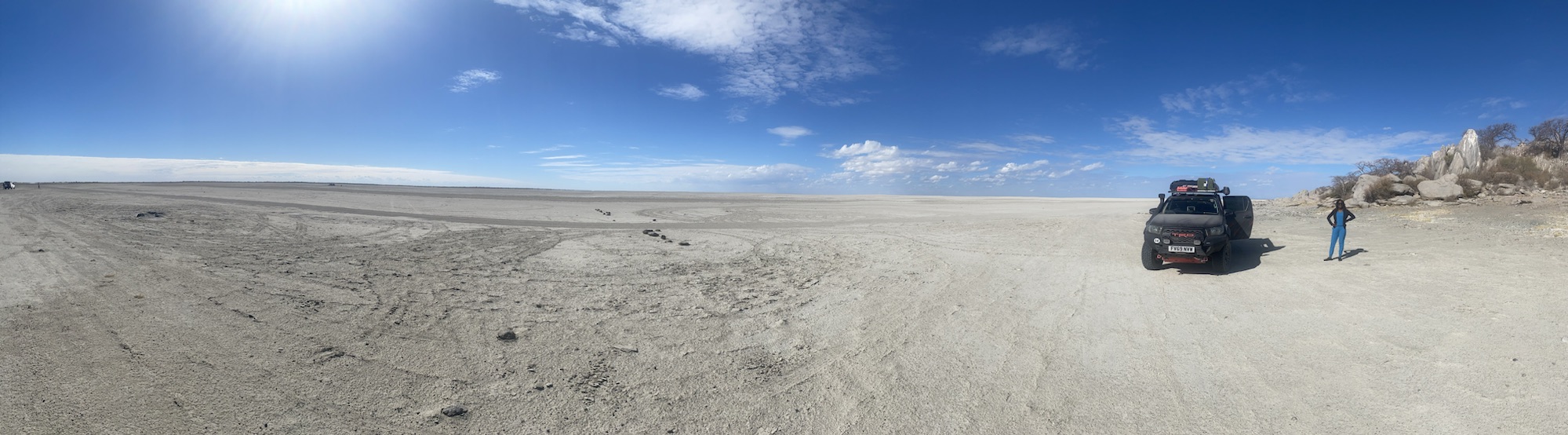
The campsite at Khubu is tucked away with minimal views across the pan. The area is unique, stunning and well worth the effort of getting there. There were clouds on the western horizon so the sunset was not as amazing as we hoped for. It was a bit windy at night so we oriented the car in a way that we could sit on the leeward side out of the wind. The 4 ammo boxes we use for storage fit nicely under the car, creating a nice wind-break. The wind was too strong to bother lighting a fire, so we had an early night.
Day 27 – Khubu to Livingstone (Zambia)
We had another long drive planned; we were hoping to make it to Zambia today. It was about an 80km sandy & dusty drive to get us from Khubu Island to the tar road. A section was very pretty along a sand ridge, with views to the left a lot like the Serengeti, and to the right across a beautiful salt pan. A lot of the 80kms were through stunted Mopane, typical Kalahari scenery and not altogether pretty to look at.
We stopped in the small town of Nata for some delicious food, to refuel and inflate the tyres back up to road pressures. The garage attendant inflated the tyres for us, and this is where a problem started. The TyrePal tyre pressure management system (TPMS) I had fitted before the trip had been gradually failing us. Over the last month, three of the sensors had been giving false readings. The fourth one I had lost somewhere in the Caprivi. The TMPS display was therefore switched off as it kept beeping false readings. The garage attendant didn’t screw the sensors back onto the valve, and I made the fatal error of not checking. Not screwing the sensors back on properly causes air to leak out of the valve.
About 150kms down the tar road from Nata towards the Zambian border at Kazangula, I felt the front right tyre fail at about 100kmh. I braked gently to try to keep the car going straight, and the tyre came rolling past us. After what seemed like forever, I brought the car to a standstill on the wide flat dirt & dried grass verge.
We changed the wheel and were back up and running in just over half an hour, and made it to the border post by 4pm. It took us about 1 1/2 hours to get through the border. Its all very nice and new and a fairly easy process by African standards, although in trying to make things easy it all ends up being a bit of a faff. There was a lot of paperwork on the Zambian side: Insurance, carbon tax, Local tax, bridge charge. All which had to be paid for. Then there was a gate pass, some form to fill in where they measure how efficient they are, and a health check done by an infrared camera. Also some stickers for the front & rear of the car, required by Zambian law. Then money changing and finally getting SIM cards so we have data. All fairly easy to negotiate and much easier than I expected.
We found Glorias BnB in Livingstone on the Garmin. She has a very nice small house on the grounds for £40 per night. Hot shower, big kitchen, lounge, comfy bed. Suma kept purring like a cat in a cream factory.
Day 28 – Victoria Falls
Wheel repair & car clean took us up to lunchtime. We drove to Vic Falls in the afternoon. We paid 100 Zambian Kwatcha (£3.20) for someone to guard the car from baboons in the Vic Falls car park. We returned to find the recently cleaned car covered in baboon shit & piss and the front bonnet stone guard half chewed and hanging off. All baboons should be rounded up and shot.
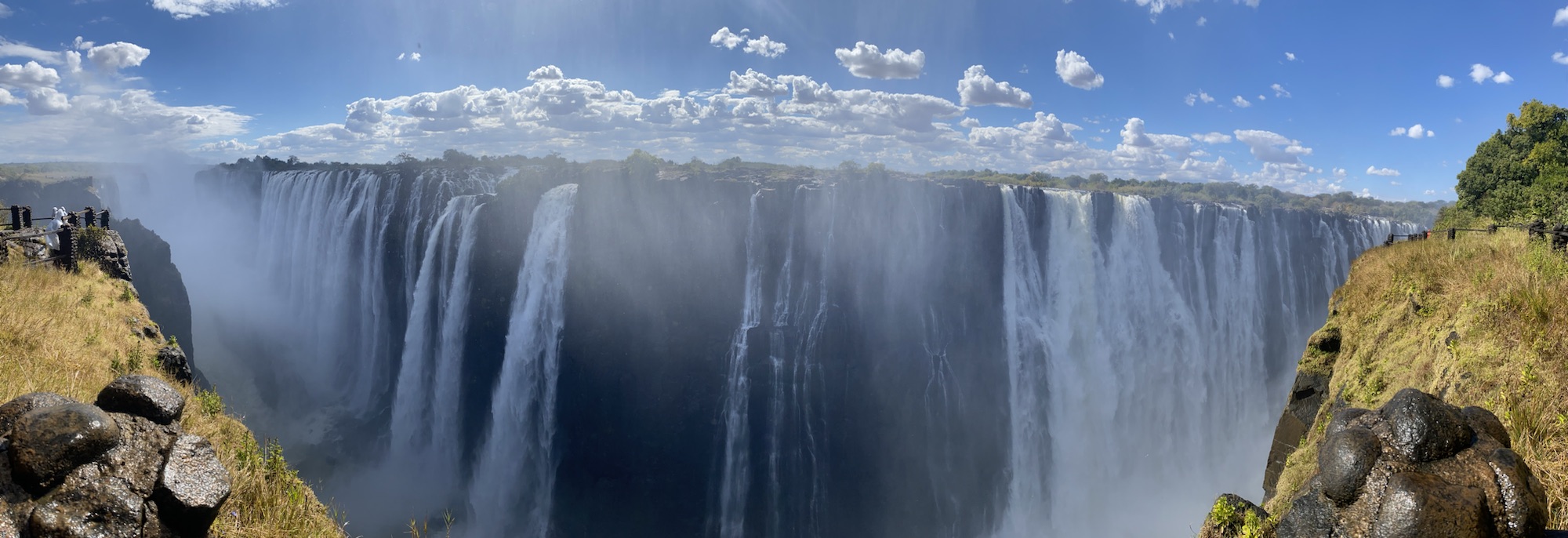
The falls were predictably spectacular, rightly being the number one tourist destination in this part of Africa. It’s for sure one of many trip highlights so far, and surprisingly not overly touristy. There are plenty of stalls selling wood carvings, bracelets, fabrics and all of the tourist tat that you’d expect, but no hard sellers pestering you to buy stuff. It was nice to see so many Zambians visiting the falls – we were far outnumbered by people travelling down from the larger Zambian cities for the weekend to see the falls, helped by the dual pricing system for locals and international tourists. Surprisingly it wasn’t overrun with hoards of Chinese tourists or overland groups.
We booked a 3 hour sunset cruise which was lovely. It took us upstream, then across to the Zimbabwean side of the river and back downstream to view a lovely sunset. It was very nice, we saw some elephants and crocs; one of the crocs was massive. We got chatting to a Zambian couple. The guy was a safari guide working out of South Luangwa NP, and we had some drinks and a chat.
He was lamenting the issue of (mostly) American tourists getting themselves killed by elephants in the area, and how the reporting in the international press was seeming to tar the reputation of Zambia as a tourist destination. These elephants are not ‘Zambian elephants’. They migrate across 4 countries, so don’t belong to any one country. The problem is caused by people not reading their behaviour, and refusing to get out of the way when an elephant is agitated. The results are a sad loss of life, and a damaged tourist industry.
The wheel was ok, tyre swapped over and everything cleaned up nicelyCool double rainbow at Vic fallsSunset Zambezi river cruise
We tried (and failed) to meet Suma’s brother Gwmaka. He was just over the border in Zimbabwe. The visa costs for us to cross over into Zimbabwe for 2 hours were too high.
We then had a long drive ahead of us as we wanted to get as close as possible to the Lower Zambezi National Park. It took us the rest of the day to get to Gwabi lodge/ campsite, arriving there well after it got dark. it was a dull drive on nice smooth tar roads. The section through the mountains towards Chirundu was very pretty, although there were plenty of broken-down trucks blocking the roads. We didn’t see much of Chirundu. It’s a hectic border town between Zambia and Zimbabwe, so there are trucks and people everywhere. Zambia’s lack of electricity at nighttime give the place a surreal feel to it. The only light is from the many vehicle headlights jostling to access the border post.
Gwabi campsite (on the Kafue river) was ok for a stopover. It seems a popular spot for people who hire motorboats for the day. From the little we saw of the Kafue River, it looked very beautiful. The lady in charge seemed preoccupied and not overly welcoming.
Day 30 – Mvuu lodge – Lower Zambezi
We left Gwabi and had only a 2 hour drive to our next stop: Mvuu Lodge. We had 2 days here in order to visit the nearby Lower Zambezi national park (1 hour away). The manager John immediately made us very welcome.
The lodge has riverside chalets, a lovely bar area overlooking the stunning river, and plenty of camp pitches, 2 of which are overlooking the river. Book well ahead if you want these pitches, they are prime real estate.
The river pitches were booked but John spoke to the booking agent and found that the ‘Ele’ pitch had a last minute cancellation so we could use it for the night.
We have stayed in many campsites now, and Mvuu is definitely one of the top ones. It ticks all the boxes:
1. Great location near something awesome
2. Beautiful views from the campsite pitch
3. Great facilities
4. Really great staff who go make you feel so welcome and part of the family.
We have stayed at many sites which tick the first two boxes, not so many which tick the first three, and very few which tick all four. Mvuu is one of the few which ticks all boxes; it has the feel of a luxury camp but at a fraction of the price.
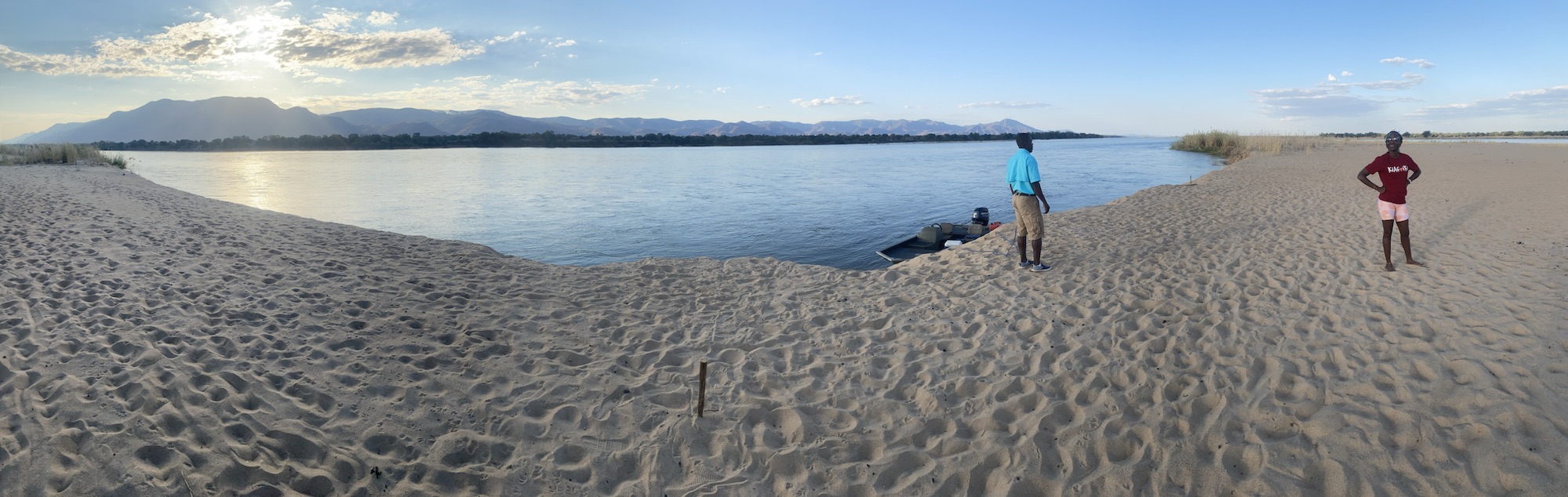
We booked a sunset river cruise on a small metal dinghy for $88 USD. It was fantastic exploring such a wild untamed stretch of the Zambezi.
There was a fault with the outboard engine electrics: a short in both the starter and trim circuits. The coxswain kept having to bypass fuses. The presence of a supply of already fudged fuses (with wire wrapped around them) meant this was an ongoing issue that should have been dealt with long ago.
Also, having an avoidable engine failure in a river full of grumpy-ass and very dangerous Hippos is asking for trouble. The manager John gave the coxswain a right bollocking for both not reporting the fault and for using a boat with a fault he knew about.
That aside, it did make the boat trip more memorable and we spent an extra half an hour on the river playing with the outboard motor.
Day 31 – Lower Zambezi NP game drive
Leopards! Our guide Shad was a top man. The ground was very dry, but plenty of greenery on the leaves.
We started by trying to look for some Lions that we were told were heading across a side channel. No luck.
We were then told that a Leopard had been spotted, and it looked like our guide was getting some very clear directions from another guide. So we headed there quickly, getting quite excited at the thought of spotting our first ever elusive Leopard. Suma spotted another game vehicle parked up near some bushes, so we towards it by barging our way through and over some small bushes and young trees. The car wrap picked up a few more scratches.
We were then able to spot our first ever Leopard! A stunning male, wandering slowly through the bush, seemingly unfazed by our presence. We followed him for a short while before allowing others to enjoy the spectacle.
We were so pleased. We have done countless game drives, and all of them hoping that we might one day see a Leopard.
We headed off to see what else we could find, winding through the bush on red dirt trails, now & again following the river with amazing views across to Mana Pools NP in Zimbabwe.
We stopped for a quick beer by the riverside. When we were almost finished, a game drive vehicle approached, and told us a Leopard had just climbed up into a tree about 100m from where we were. We had a look for him, but the tree was too large and foliage too dense for us to see anything.
Not long afterwards we saw another vehicle, the guide told us about a female leopard spotted hiding her cubs in a bush not far away.
We headed there and soon picked up the leopard pug marks and vehicle tracks. We started circling the bushes in the vicinity. We came around one bush slowly, and Suma gave out a yelp of surprise and quickly wound up her window. Right there next to here about 4ft from the car was a female leopard looking directly at us.
We stayed for a while watching while her 2 cubs suckled. They were tiny, Shad estimated around 1 month old. She eventually got tired of us and moved her cubs further into the dense thick bush, now completely hidden. it was a magical encounter, and something we will never forget.
Lower Zambezi National Park is a very beautiful area, and we are now looking forward to see what South Luangwa has in store for us.
Day 32 – Long drive out
Our next destination was South Luangwa NP. It took all day to get just over halfway there. Looking at the map it seemed like there was a nice shortcut up to the Great East Road, which would potentially save us time. Asking around it became clear that this was not a road we should attempt. The route up the Zambezi Escarpment was said to be very rough and dangerous. If you get into trouble it will be weeks before park rangers find you. You could maybe do the route with a convoy of unladen Land Cruisers, but not a top-heavy overloaded truck like ours.
We decided to take the safe but very long and boring tar-road via Lusaka. I got caught speeding by the police. The officer was impressed by my fridge and accepted a litre of orange juice in exchange for letting me off with a smile and a handshake.
We skirted Lusaka. It is like Dar Es Salaam but more civilised.
It got dark as we approached Nyimba town. There were people, animals and motorcycles everywhere, but no street-lights or house lights. We tried a few lodges but none had electricity. We found one with a bit of power, but it was one of those seedy places which charge by the hour.
The bed was uncomfortable and the mozzie net had big holes which we tried to plug using toilet paper. We tried to settle down but decided that the roof tent was bigger, more comfortable, was mozzie-proof and had 12v electrics.
So we decamped to the roof tent, which was sheer luxury by comparison. I like it in the roof tent, it feels homely.
Day 33 – Drive to Croc Valley campsite, near South Luangwa NP
A pretty dull and uneventful 5 1/2 hour drive from Nyimba to camp. We arrived around 2.30pm, so had plenty of time to relax.
We had a riverside pitch with very nice views across the Luangwa River. There are a lot of crocs on the sand bar in the middle of the river.
The campsite is lovely, and great value. Parts of it are looking a bit tired and in need of TLC, but for the money I cannot fault it. The manager Herbert is very welcoming, and on hand to answer any questions. He helped us out a lot with our onward route planning.
I had a very productive night game drive. I went in a game drive vehicle with some Afrikaaners. Incredibly, we saw another Leopard although I couldn’t get a good photo of him. Nearby was a hyena napping.
We saw several Genets too, both sightings were very clear and quite close, unusual for such a very shy small cat.
Suma stayed back at camp, relaxing by the river. With the river being so low, the campsite is about 15ft above the river level, and we were advised not to go down to the waters edge due to the high numbers of crocodiles.
While I was on the game drive, Suma watched some Vervet monkeys playing down by the river edge. A croc came bursting out of the water and tried to take one.
Day 34 – South Luangwa NP game drive
We left camp at 8.30am with our guide Musa. I was driving and Musa was looking for game.
South Luangwa is one of the more stunning parks we have visited. It is similar in many ways to Selous (Nyerere) NP in Tanzania, but with more wildlife.
The Luangwa river meanders around, doubling back on itself and forming oxbow lakes. There is a labyrinthine network of sand trails following the river and hinterland, giving superb access to all of the good game-viewing areas.
Even if there were no game here to see, it would be worth coming as it is so stunning. But there is wildlife in abundance. Pretty much everything is here, with the exception of Rhino and Cheetah.
The river has huge populations of crocs and hippo. There are many small lakes near the river, with hippo, crocs and bird life. Musa told us there are over 700 bird species in the park.
After about 3 hours driving around without seeing a predator, Musa spotted a Leopard resting in a tree on the riverbank. We parked in the shade of the sand tree and sat watching him for a while.
We headed off, and 2km further along the river we saw another Leopard sitting in a bush. We sat and enjoyed him for a while then headed off further into the park to look for wild dogs.
We didn’t find them nor any Lions. At our lunch stop next to the river, a guide car pulled up and said he just saw a Leopard climb up into a dense tree just 50m from where we were snacking. We had a look for him but the foliage was too dense. This place is Leopard paradise!
Time was getting on so we began the drive back towards camp. A guide car stopped us and told us of a Leopard sitting just by the road nearby. It was the same Leopard we had seen a few hours previously: he had come out of the bushes and sat in a much better spot for us to photograph him.
We got back to Croc Valley camp around 3.30pm. I was pretty tired after driving all day so I had a nap in the camp chair by the river.
We were both a bit knackered after a good few days of driving, so we opted to stay for an extra night so we could sit around relaxing, and I could get ahead with work chores.
Day 35 – relaxing at Croc Valley Camp
Nothing interesting to report; a much needed rest day, well spent in a lovely camp.
In order to avoid the 3 day boring tar road via Lusaka, we had 3 options to get to Tanzania:
1. The hard but short way: From SL there is the notorious ‘05’ road which leads directly up to the Great North Road. It has a tricky river crossing at the start (only recently rebuilt and made navigable) followed by a difficult ascent straight up the Mafinga Escarpment. Locals said it was OK, and people had been using that route recently. Estimates were at 4 hours, but that is overly optimistic.
2. The easier but longer way via North Luangwa, staying at Somala Camp when exiting the park. Herbert and several others recommended this route. It was said it could be done in a day.
3. The easy way: go back to Chipata, cross into Malawi and cruise up the road along the incredible Lake Malawi back to Songwe over into Tz.
Option 3 would be awesome, but we have already driven that road, and we haven’t yet been to northern Zambia. Malawi will be visited again on a future trip.
Option 1 sounded a bit hard, considering my lack of rock crawling experience. Option 2 sounded interesting, and would enable us to see more of northern Zambia: some waterfalls etc.
So we got up early and headed towards North Luangwa. We needed cash and the ATM wasn’t working in Mfue (usual power outage), so we had to divert to Mfue airport: they have an ATM and a generator to keep the airport operational for the Safari tourists.
We started on the dirt road a bit late at 9.00am. The road roughly follows the Luangwa River upstream (northwards). You get occasional sightings of the river, but it’s mostly narrow sand tracks, countless dry stream & river crossings and a lot of mud hut villages. As expected, the huts were all beautifully and skillfully crafted, and well maintained. Courtyards were all kept well swept and there were no signs of litter.
Friendly locals returned our waves with a wave and a smile. Children chased after the car with their hands held out looking for sweets or money.
This dirt track just kept taking us further into the wilderness. We crossed part of SL NP and Luambe NP. Since we were transiting, we didn’t have to pay any park entry fees.
There were numerous small villages dotted amongst the lovely Miombo & Mopane bush. We didn’t see much game: some Zebra and Elephants. Maybe the locals hunt the game outside the parks.
An easy section of the sand road from South to North Luangwa
After many hours we reached the pontoon raft which crosses the Luangwa river into NL NP. There is no charge for the pontoon, but they accept donations. I gave them 200 Kwatcha (about £6).
The raft was made from old oil drums welded together and some wooden planks on top. The raft was pulled across the river by hand, using a cable.
Four of the workers jumped on the raft to help it across. There was a lot of grunting and heave-ho-ing, and the raft very slowly inched its way across. Three guys jumped in the river to push it along, again with lots of grunting. I was a bit puzzled: the raft clearly wasn’t beached. A grounded raft wouldn’t move at all, it would be firmly stuck. This raft also takes much heavier fully kitted-out Land Cruisers. The river depth was just above knee height, so there would have been 1ft clearance. I was considering the options: the water wasn’t too deep and it could be driven through off the front of the raft if need be.
I noticed a spare spot on the heave cable, so jumped on it to give the guys a hand. To my surprise, the raft then started moving quite easily across the water. Now I’m not at all strong, certainly not when compared to these wiry bush-folk. Suma mentioned that we should give them a bigger tip considering how hard it had been for them. I disagreed. They certainly put on a good show.
Then there was an uneventful drive through NL NP. We didn’t see any game at all, but were moving too quickly to spot any.
Due to time constraints, I had been driving as fast as I could safely and respectfully do so (going very slowly through villages and past people so as not to cover them all in dust). The road was very slow going in places, with many river crossings, washouts, ruts, tree roots and all manner of easily navigated obstacles, provided you cross them slowly. I had to almost lock up the wheels a number of times to scrub enough speed off in order to deal with these obstacles. If you crawl along these roads it will be a 2 day drive.
Not wanting to be driving these bush roads at night, we were racing the sun towards the end. Through the Rhino protected area the roads were very lumpy and had a lot of loose large pebbles, with frequent speed bumps, making for very slow going. This was intentional by the park services, probably to hinder poachers.
After leaving the rhino area, the roads were a lot smoother, so we made better time as we climbed up the twisting road up the escarpment, the vegetation getting lusher, taller and greener after every turn. We eventually arrived at Somala camp just after sunset but before dark had fully descended.
In all it was 9 hours of intense narrow bush road driving from Mafue to the northern border of the NLNP. A long, tiring day but well worth the effort. With hindsight, and more time, I would definitely break this journey up over several days; there is a campsite near the pontoon, and this would be a great spot to explore North Luangwa. It is a very remote area, so you would need to bring everything you need for the duration of your stay.
A hot shower, a chat around a big camp fire and a few drinks was a good end to a tough but awesome day.
Samala CampSamala Camp
Day 37 – Kapishya hot springs
We had a chilled start to the day so we could enjoy our surroundings before leaving. Samala is a fairly new camp. The facilities are great, the camp pitches are right next to the Mwalushi river, a small but lively river originating further up the escarpment, noisily gushing past camp to feed into the Luangwa many miles below.
It is very lush and green here, the trees are taller than in the plain below, and theres plenty of moss growing on the rocks. it reminds me of wild camp spots in mid Wales.
We are only about 1 1/2 hours drive from the great north road. Our next stop at the hot springs is not far from there. We will go there and hope to find some locals or fellow travellers to help plan a route for our last week in Northern Zambia. There are countless beautiful waterfalls here, plus some nice beaches on the southern shore of Lake Tanganyika. It will be a case of picking an achievable route through the area, to see some highlights within the limited time we have.
On the way to the hot springs we drove through a really odd place called Shiwa. It’s a large 1800’s Wild West Montana style ranch, with elements of English country estate and sets from US slave plantation movies. Plus a few Zebra roaming around. Very strange place indeed, and still very pretty.
We arrived at Kapishya hot springs lodge & campsite by noon, and were immediately taken aback at how beautiful it is here. We had arrived in Eden: the land of milk & honey. Even if yesterday hadnt been tough, we would have decided that this place is too nice to stay for just one night. We decided to just relax here for 2 days, spending most of it in the spectacular hot springs. This is undoubtedly one of the best campsites of all time. It is absolute paradise. The owner Mark was a really nice guy, and was able to tell us about the local history: his grandfather originally purchased the estate towards the end of the colonial era, and helped steer what was then Northern Rhodesia into a peaceful transition into what is now Zambia.
Evening drinks in the hot springKapishya CampsiteLovely bar area at KapishyaThe temperature is perfectWe decided to stay here for an extra night
Day 38 – Kapishya rest day
We had about 4 hours in the hot spring and did a short walk up a nearby hill. The views from the top were very nice: Forested low hills and broad green valleys stretching far off into the distance.
Day 39 – Drive to Kalambo Falls
We left Kapishya around 9am and headed down the dirt road to join the Old Great North Road which goes all the way towards Lake Tanganyika and the Tanzanian border.
There was nothing Great about the road. With the exception of an approx 20km section of smooth road (for which a 20 Kwatcha toll was payable), the road was in a dire state. It was the worst tar road I have encountered ever.
Countless large nasty potholes were everywhere, and many sections looked like Swiss cheese. By the time you have got the car into 5th gear, a rough patch appears and you then have to virtually stop, crawling through in first or second gear. Then crawl along, find a clear bit of tar, get back up into 5th gear and then have to stop again. Rinse and repeat for approx 300km. It made my left knee ache with all those gear changes.
If you lose concentration and hit one of these holes at speed, it’s game over. I often misjudged the depth of the smaller holes and it led to some loud bangs as the car went over them. It’s not a road I’ll ever drive again, probably ever.
The 30km dirt road to the Kalambo Falls Campsite was in pretty bad shape too, the final section being a fun rock crawl down a steep incline. We arrived with just enough daylight left to go have a look at the famous falls.
They are very nice. Due to the shit condition of the roads in northern Zambia and the tragic border crossing at Tunduma, not many foreigners travel here. They understandably opt for the easier and very spectacular drive through Malawi.
The campsite was empty. We looked at staying in one of the rooms, but there was no electricity or running water so we camped instead. The very friendly and helpful campsite workers gave us firewood and brought down some buckets of hot water. They let us use the shower room and toilet in a nearby Banda.
Kalambo Falls – Zambian sideKalambo sunsetKalambo Falls – looking towards Lake Tanganyika
Day 40 – Travel to Tanzania
We left early for the long drive to our next stop: the famous Lake Shore Lodge on Lake Tanganyika.
We were expecting an easy border crossing from Zambia into Tanzania, but it ended up taking about 3 hours. We had to pay $50 USD each for a visa. We had plenty of Tanzanian Shillings (Tsh), but for some reason they only accept USD. Why you cannot enter a country and pay for a visa in the local currency baffles me.
We had no USD, so I tried to do the visa application online. It was a real pain: slow WiFi hotspot, the website kept freezing, loads of ridiculous questions, multiple documents to upload (with annoying file size limitations resulting in me having to edit stuff in photoshop) etc.
The immigration and revenue guys were really helpful though, and did their best to help us through the process. In the end, we got around it by transferring the Tsh equivalent of $100 USD into an immigration officers personal bank account. He then gave us the $100 USD cash so we could get our visas. He was happy to give us the dollars and for us to drive away to Sumbawanga, then transfer the money his account at the bank. That was very trusting of him.
We managed to get Suma’s Tz CRDB online banking app working so we did the transfer there and then. After spending more time sorting out new Tz SIM cards and data plan, we left the border post. A word of caution: when arranging a new SIM, a common scam is for the agent to connect the MPESA to his own bank account, so if you pay using MPESA then he will pilfer the amount. The agent pulled this scam on us, but Suma noticed before any funds had cleared. She had to visit the bank and also get a new SIM. This will only affect you if you use MPESA, which most tourists wont.
Starting the car brought up some engine warning lights on the dashboard. I had gone through a stream crossing a bit quickly earlier that morning, so I wonder if some water got into one of the many sensors on these new vehicles.
I checked the oil and knocked some dust out of the air filter. Everything sounded and looked fine with the engine, so we carried on to the next large town: Sumbawanga. This place is apparently known in Tz for having lots of practitioners of witchcraft and juju nonsense.
I didn’t need the services of a witchdoctor, just a mechanic with a computer to plug in and diagnose the fault with the car. We managed to find such a guy: the faults were related to the air/fuel mix, and some exhaust gases. He cleared the fault, gave the air filter a proper clean and we went on our way.
The warning light came in again a few miles down the road. I’ll get it looked at by a proper garage in Morogoro.
We reached Lake Shore Lodge in time to see the beautiful sunset over Lake Tanganyika. The mountains of the Congo are just visible in the distance on the western lake shore, but only at sunset when the sun drops behind them.
This is a luxury lodge in a remote part of Tanzania. The owners and staff are very welcoming and the place is everything you would expect from reading the many gushing online reviews. I’ll say just this: we were wondering how we could find anywhere more awesome than Kapishya. This is that place.
It is far from the regular tourist trail, so sadly gets far fewer visitors than it deserves. The quietness does add to the charm though.
The usual clientele are here are on long overland journeys, so come here for a few days of luxurious R&R, a welcome break from the trials of long trips through Africa.
We opted to splurge $145 USD per night for 3 nights in a luxury Banda right on the lake shore. The water level in the lake is extremely high at the moment; an El Nino event earlier in the year resulted in a huge increase in rainfall. This, plus other factors have led to all the Rift Valley lakes being very full this year. Three of the lakeshore bandas were submerged in the water, a very sad situation. The water level is slowly dropping though, so hopefully they will be able to renovate next year.
Paradise at Lake Shore Lodge, Kipili, TanganyikaAnother stunning sunset, Lake Tanganyika. DRC mountains just visible in the far distance
Day 41 & 42 – Lake Shore Lodge
Two days relaxing by the lake shore, doing emails and work. But mostly doing nothing.
The afternoon on our last day we drove into the nearby village with a very helpful but smelly chap to eat some good local food. I was getting bored of noodles & crisps and fancied something nice, tasty and cheap. The dinners at the lodge, as amazing as I’m sure they are, are a bit pricey.
We got a meal in Kipili for 50p each, (rice, ugali, beans and greens). I splashed out £3 on a kilo of the best kitimoto (roasted pork chunks) ever.
Suma handed out some sweets to the local kids, who all had fantastic manners, a credit to them and their village. In Zambia if you hand out sweets, both the kids and adults scramble, wrestle and snatch, without so much as a smile or thank you.
Suma was chatting with a very small toddler girl who was interested in her shades. On spotting me she quickly ran back into her house/shop and hid. Suma called me over to come take a look. The terrified little girl had curled up in a ball with her head buried in the corner of the room, her tiny bare ass on full display. Very small children seem to be quite terrified of white people.
We left our friends at Lake Shore Lodge after a couple of very relaxing days, and began our journey to Morogoro. Suma needed to fly out of Dar on 17th July to head back to the UK to fetch our 2 kids, returning on 20th July. A bit of a hectic turnaround but circumstances were as they were.
The drive from Kipili to Mbeya was long – it took all day and was uneventful. Tanzanian roads are in better condition than Zambian roads, but they are very hectic. Arriving in Mbeya, we stayed at the swanky Royal Mgwasi Hotel, where we got to catch up with Sumas cousin Joffrey. The hotel is brand new as of 2023 and is as good as any high-end hotel in Europe. The price was very cheap at 120’000 Tsh (about £35 GBP).
The food in the restaurant was very nice but took 2 hours to be cooked. I was getting ansty as the Euro final UK vs Spain was about to start and I wanted to head to the hotal bar to watch it whilst getting a few beers in me. Suma headed to visit her cousin Rehemma in hospital with her young son while I pretended to watch the game and made a new friend, who happened to be from Kandete (where Sumas dad grew up). Despite a significant language barrier we managed to have a conversation, and I didnt watch much of the shit football match (which we lost). At the end of the evening my new friend insisted on paying the bill, which was extremely kind and well appreciated. Tanzanian hospitality!
Next morning we got up early and had a huge drive to Morogoro. We left around 8.30am and arrived in Morogoro well after dark.
There were plenty of trucks parked upside-down in the roadside ditches, as per usual in Tanzania. Fresh crashes are usually surrounded by people pilfering the goods which spill everywhere. We could have filled our truck with slightly bruised tomatoes, but we chose to drive on instead.
The infamous Kitunda pass was pretty easy going. We negotiated it just before dusk, when all the crazy inter-city coaches had long passed through. We only had to deal with crazy truck drivers. Fully loaded trucks travel at a snails-pace. Empty trucks are driven like go-karts on a race track. Empty fuel tankers are the worst.
The road from Mbeya to Morogoro goes through some very beautiful scenery. Food grows everywhere, so we made quite a few stops at the roadside stalls to load up on fresh food to eat while we stay at Grace’s house in Morogoro.
It was great to see Grace and all the family/friends again. The next day we completely emptied the car and gave everything a good clean. After more than 6 weeks of hard travel, the first leg of our journey was done, and everything was in need of a deep clean. I made some adjustments to the canopy, attempting to make it dust-proof.
Suma got the new high-speed train to Dar Es Salaam for her flight the following day. I relaxed for a couple of days and caught up on work emails.
We left Morogoro to start our month-long journey around Northern Tanzania, looking forward to seeing beaches, mountains and the world-famous national parks. We headed towards Bagamoyo as there were meant to be nice beaches there. We did a day trip to the ruins there some years ago. The place didn’t impress me much then, so I thought it would be worth another visit to have a better look around as maybe I had judged it too harshly. We arrived in town around mid-afternoon, and it is quite a tired scruffy-looking place. On opening the windows to get some fresh air in we had to close them pretty sharpish. There was an overpowering stench of rotting fish, rather like the fish market in Stone Town on Zanzibar. Being a Brummie, Im not partial to fish at the best of times.
We were looking for a campsite; the first one had a bad report on iOverlander: there was said to be a loud bar nearby blasting music all night. As it was a Saturday, we decided to head further out of town to avoid the noise.
We found a decent beachside campsite, with a pitch not far from the beach. The beach was a bit dirty, there were bits of rubbish floating in the water and plastic above the high tide mark. It was a bit windy, so the sunken firepit at the campsite was useful. The music and MC at the local night-club started pumping out noise fairly early, and continued until just before the hundreds of Mosques started noisily calling people to morning prayer. Soon after the Muslims quietened down, the Christians got their hands on the nightclub sound system and a preacher began loudly ranting all morning (being a sunday). So Bagamoyo is noisy, dirty and smelly. It seems my first impressions years ago were spot on.
Days 59 – 61: Pangani beaches
We decided that one night in Bagamoyo was plenty, so moved north towards a fairly remote stretch of beaches near Pangani. An old white Zimbabwean I had chatted to that morning in the campsite had said it is very nice south of Pangani. Getting there was a circuitous route around the Sadaani National Park. It is quite a unique national park in that it is coastal – you have the chance to spot wildlife coming onto unspoilt white sandy beaches. Sadaani is not highly rated amongst fellow travellers nor Tanzanians, so a drive through there was deemed not worth the expense. It is a fairly new park, and the wildlife numbers are not great yet. We would be paying hundreds of USD to look at a nice beach.
We drove to Pangani down a 30km stretch of gravel road, sampling by far the most delicious Pineapples I have ever tried before turning off the tar road from Bagamoyo. Its worth the drive just to sample these extraordinarily sweet pineapples. Getting to the campsites south of the Pangani River is via car ferry, and we got a bit lost going through Sisal plantations. There is a new coastal road being built and the diversions are a bit confusing.
We arrived at Beach Crab resort mid afternoon, and they had an amazing pitch right next to the beach. The place is very run-down. It looks like a typhoon came through there and ripped apart half the buildings. Its a bit like an abandoned Oceanside camp from the AMC Series The Walking Dead. Its a real shame as it looks to have been fantastic in its heyday. The German owners are absent and have been for some years, leaving a drunkard in charge, with his hard-working mistress (who is an excellent cook and would make a far better manager).
Since we are mostly self-sufficient we decided to stay on this lovely beach pitch in the middle of a badly run-down campsite for 3 nights. And we really enjoyed it. The toilets & showers worked fine, although there was a persistent floating turd in one of the toilets (not one of ours I must add). It may still be there to this day.
We did a boat trip to Maziwe Nature Reserve, a small tidal sand island surrounded by a coral reef which is achingly beautiful. It was an amazing day in a stunning place. I got sunburned as I forgot to reapply the factor 50 after playing around in the surf with the kids. I got to teach Reece how to snorkel, and we spent about an hour and a half exploring the coral reef. The reef itself isnt that great, but it was far nicer than the Zanzibar reef i had seen on a previous trip. We shared this paradise with only one other group in another boat.
Day 62 – Zebra campsite on the Pangani River
Keen to continue our adventure northwards, we reluctantly left the beach and headed north. We stopped off at Amboni Caves in Tanga, which was quite nice. Its nothing compared to the Ardeche Caves we visited in France, but it was filled with bats. It was a pretty awesome sight to see and hear a cave-full of bats. They are noisier and smellier than you’d think. It was like being in Batmans Batcave. We then drove on to Zebra campsite on the Pangani river on the way towards Moshi. It was a nice riverside pitch, very cheap and with basic facilities. Perfect for a stop-over. The nearby town had basic street-food type restaurants. We stopped and had a local Tanzanian delicacy – ‘Chipsi-mayai,’ which is an odd dish made from chips mixed with a couple of eggs. A bit like a chippy omelette. The advantage being that they make them fresh and they are cooked hot, so chipsi-mayai is quite safe to eat in places of questionable hygiene standards.
Day 63 – Moshi stopover campsite
We arrived in Moshi needing to stock up on food and booze, so we headed to a supermarket and then stopped for food at a restaurant opposite. We got chatting with a really cool and interesting retired Dutch bloke, we invited him to eat with us so we could continue speaking to him. He suggested we headed up the hill to Maisha Khalisi campsite. When we got there the price was a bit steep – they wanted $60 USD for 1 night so we left. After a bit of driving around trying to find somewhere with decent prices we finally found Nyange Farm campsite. It was cheap, clean and very nice, with good ablutions. A great place to stay for the night.
Day 64 – Tarangire – Wild Palm Campsite
This locally-owned campsite is not far from the main tar road and dirt road access to Tarangire National Park, so is a perfect budget-friendly base to explore Tarangire. Its also not far from Lake Manyara too, although we didnt visit there. We had the campsite to ourselves for the first night, and the owners arranged a safari vehicle for us for a night drive, then a full-day drive the next day. We negotiated a price of $400 USD for the 2 game drives for 4 of us. We also had to pay park entry fees on top of this too, pay extra for a night game drive (this is a ‘special activity’) and also some extra for an armed ranger to accompany us.
The game-drive vehicle arrived, and it was not quite what we were expecting. All game drive vehicles in this area are modified Land Cruisers with glass windows (to keep out the dust). Our vehicle was an ancient open-sided Suzuki Jimny, but the Indian Maruti version. It was in terrible shape, and it had lived a long, hard life. What hadn’t already fallen off rattled very loudly; even on minor corrugations the sound was deafening. The starter motor was almost dead, and the clutch/gearbox was knackered too – the car engine needed to be switched of to change into and out of reverse.
This did make me chuckle somewhat when we were later surrounded by lions, with the almost lifeless starter motor slowly cranking the engine over.
The night drive was fantastic; we took our ‘midnight sun’ torch out with us so we had 2 searchlights to help us spot wildlife. Reece had a great time spotting animals’ eyes lurking out there in the darkness. We saw some Genets, Bush Babies, and had several lion encounters. There were very few other vehicles out in the park during the night, so we were mostly alone.
I headed to Dar Es Salaam on the friday night, using the new high speed train. It is awesome. 2 hours of relaxing in comfort, versus the 5 or 6 hour crazy drive with endless police traffic stops, speed limits and slow trucks. The time went pretty quickly as I chatted to a tractor salesman from Dodoma who was sitting next to me.
I was met at the station by Sumas cousin David, we got into a bajaji (tuk-tuk) and headed the short distance through crazy traffic to her brother Jons’ place in Upanga East. Jons, David, Ole (Maasai) and me headed out about 9pm for some food and drinks.
We went to the well known downtown bar/club Samaki-samaki after food. I tried to order a round of large whisky & cokes. Somehow it got mixed up with all the noise and the waitress arrived with a 75cl bottle of Jack Daniels and 4 cokes. The night got a bit messy from there on. We ended up in an upmarket club called XII – XIV and got back to Jons’ flat around 5am. I haven’t stayed out that late in a good few years. Great night.
The next day was mostly napping and recovering.
Day 52 – Kids arrive!
Suma and the kids were due to land at Dar Airport by 4pm, so we decided to head to Mbweni JKT to see the plot of land and chat about how to develop it. We got halfway there when Jons’ Mercedes E-class started to overheat (we had sent it to him from the UK a year previously). We couldn’t continue, so we waited while a mechanic came with a computer to diagnose the problem.
David and me got a bajaji to the airport to find Suma and the kids there waiting for us. It was great to be reunited with my boys after 7 weeks away from them! We headed to Jons’ flat then headed out for some food and a shisha, getting an early night.
Day 53 – Coco Beach
Suma went to get her hair done so me and the boys headed to Coco beach. The kids played with car inner tubes in the surf while I sat in the shade. Later that afternoon we headed to Morogoro on the evening train, arriving at Grace’s house around 9.30pm.
Day 54 to 57 – Hanging out in Morogoro
We spent this time relaxing with Grace, venturing out to town now and again, to the farm, Mzumbe and hiked to a very nice waterfall in the nearby Uluguru hills.
A nice clean carFun on Coco Beach, Dar Es SalaamWaterfall walk, Uluguru Mountains, MorogoroTwo Reeces!