Day 65 – Tarangire National Park
The next morning we woke early to leave at 9am for a full-day game drive. Due to the dust being kicked up by road improvements on the NP access road, our driver took us on a diversion through Maasai villages: they now live in permanent settlements with access to schools and healthcare.
The car park at the entry gate was rammed full of safari vehicles, all checking permits to access. The park is very busy, and this was our first taste of just how busy the Tanzanian Northern Safari Circuit is.


Our drive was great; the park has a great mix of dense short woodland, semi-open scrub and pockets of grassland. The Tarangire river is also very pretty, and there are some lovely riverside drives. The river is too low for crocodiles and hippo.
We were lucky enough to see two Cheetah relaxing on a rock outcrop. They also walked quite close to our vehicle. This experience we shared with maybe 50+ other safari vehicles. You join a queue of vehicles and inch forward, so everyone gets a chance to view the game. A handful of idiot drivers try to bypass the queue and cause huge traffic jams, completely blocking the road in both directions. All to please their clients, who are somehow more important than everybody else.

We stopped by one of the expensive lodges for a quick toilet break. It is built on a bluff overlooking the Tarangire River, so we had a look from their terrace. The view was amazing, but for $765 USD per night for 4 of us (Josh is 13 so charged as an adult) it was way beyond our price point. If you have the funds, it would be pretty amazing there.

After a fantastic game drive, and we had finally had enough of the rattling noises from the car, we stopped at a cheap restaurant for tea then headed back to camp. Our guide then told us that the Rangers had called him to complain that the ranger who had accompanied us the previous night was upset that we had not paid him. We pointed out that we had paid for everything at the entrance gate, including the ranger fee. The guide said that the rangers expect a Tsh 20K tip (around £6). If this ‘tip’ was not paid, then the guide would not be receiving any more rangers for future night drives. Whether this was a ruse to increase his tip Im not sure, but we left the issue to be resolved between the guide, the middleman and the ranger. We gave the guide a tip regardless, as is customary in all countries outside the UK.
Although the camp was basic, and the safari vehicle not the best, we thoroughly enjoyed every minute. Also, it felt like we were supporting the local community a little; everything we paid (apart for park entry fees) went to Maasai-owned businesses. Expensive high-end package tours, amazing as they are, give little back to the local communities whose ancestral lands they operate in. Very high park entry fees go straight into TANAPA’s accounts. TANAPA reinvest the bare minimum into the park facilities, (which are shite) so its safe to assume little goes back into the local communities. There is abject poverty in the villages bordering the parks.
On returning to camp we found it was overrun with a huge party of Kenyan overlanders. One or two were happy to chat, but most were busying themselves with camp chores. One had pitched his small ground tent 2ft from our car, so it was like a European campsite in summer.
Day 66 – Lake Natron


Next morning we woke up to find the campsite empty again – the Kenyans had woken up very early in order to reach Iringa that day (a very long drive!).
I decided against going to Ngorongoro due to the huge cost of visiting there, but we still wanted to visit the Serengeti. The obvious route takes you up to the north gate via Lake Natron. Our aim was to find a camp near the lake. The drive along the gravel road was stunning, with the scenery wide open, dry, and desolate, like parts of Namibia. You can see the wall of the Rift Valley for much of the drive. We paid some money to the Maasai at the entry gate (this is a Conservation area, the entry fees going to the local council, so stays within the community). World View Campsite popped up on iOverlander, and the name sounded attractive; we like nice views. We could see it up on a bluff overlooking the wide valley, which is dominated by the majestic and perfect volcano ‘Ol Doinyo Lengai’.
We did a walk to a nearby waterfall. The trail starts quite easy, but the last few hundred metres involve wading and scrambling. The waterfall itself is very nice, the last stretch you pass through a narrow slot canyon. Its very nice and worthwhile if you have a couple of hours to spare. The water isn’t too cold. You have to pay to visit the waterfall, and also take a guide with you. The money stays within the community.
We decided against staying for another day due to time constraints. There are other excursions you can do in this area, such as: sunrise hike to Lake Natron, or a strenuous hike up the volcano (said to be the most challenging single day hike in East Africa). Maybe leave this for another trip when im a bit fitter – 2 months of sitting on my arse driving across Africa isn’t exactly the sort of training needed before tackling such a hike.
Day 67 – Northern Serengeti
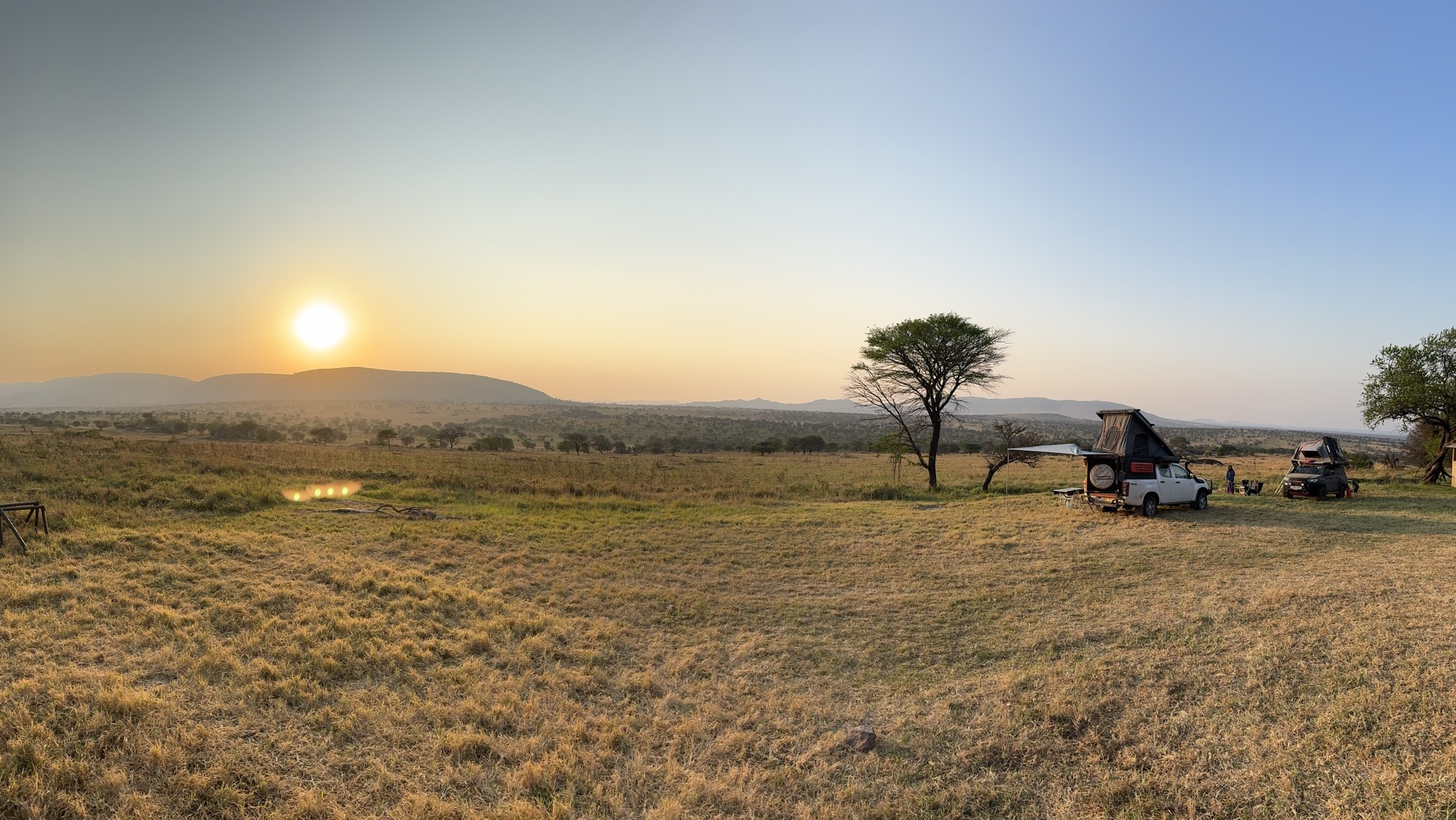
Leaving fairly early we made our way towards the Northern Serengeti, entering via Klein’s Gate. We paid for 3 days and 3 nights at the public campsites. You can use any of the public camps, they don’t need to be pre-booked. The area surrounding Klein’s gate was being burned, so was not that pretty to look at. We drove the 20+ km to Lobo Camp. Lobo camp is in a great location. It has superb views across a wide valley, and 2 resident Lion prides whose territories meet near the camp. It is a model camp that all other Tanzanian National Park Public campsites should take note of. The toilets & shower block need updating, but they were clean. Tired facilities can easily be overlooked when the location is a spectacular as this; great views and abundant wildlife make this a very special camp.
The campsite was fairly quiet, there weren’t many other groups. We decided to pitch up on the edge of camp, giving us the best views and also bringing us closer to the wildlife. Having a rooftop tent gives a feeling of safety. When evening came one of the camp staff sold us some firewood, and we sat around the fire drinking and chatting. Camping in such a place and being safe, especially with children, means there are a couple of sensible precautions; 1. Light a fire at night. 2. Keep the kids very close – sit them in the middle of the group, not on the edge. 3. Nobody wanders off.
A pride of lions began roaring soon after it became pitch black. It was quite loud so I estimate about 200m to 300m away. Not long after, the roaring started again, and it was getting louder. Ten minutes later the roaring started again, and it was louder still. I couldn’t see anything using the high powered torch, but the kids decided it was time for bed. They scampered up the ladder pretty sharpish, me and Suma finished our drinks and followed them up soon after. The lions continued to roar through the evening.
We were aware of something eating grass outside our tent, I popped my head out (definitely not something you can do with a ground tent BTW) and it was a large lone Buffalo grazing peacefully just outside the camp. Going back to sleep, we were woken up by a loud roar outside the tent. Looking out again I saw the same Buffalo charging a lone female lion. The lion retreated and disappeared off across the open grassland. The lion pride kept roaring, off in the direction the female lion had travelled, and we heard noises consistent with lions attacking the Buffalo. Shining the torch across the grassland again, one of the camp staff asked us to stop using the torch. We switched it off and tried to get back to sleep, without too much success. I was concerned at the damage a 1 ton Buffalo running through camp could cause to my camp table, camp chairs and car. There were some people in ground tents pitched in the middle of the campsite too, and they wouldn’t fare too well either against a rampaging buffalo.
Day 68 – Northern Serengeti


Next morning the grassland was empty – no sign of Lions or Buffalo, so we assumed the Buffalo had successfully fought them off. The camp staff explained why shining a torch during a hunt was a bad idea: when in trouble, the buffalo would head towards a source of light thinking it would be heading to safety. They had an incident where this had happened, and a buffalo being chased by a pride of lions had caused some chaos in camp.


We got chatting to a friendly Italian newlywed couple, who had been in one of the ground tents. Their guide, Sam, said we could follow them on a game drive way north-east to the Mara river, where we would hopefully see the Great Migration of the Wildebeest. The drive was quite long, through lovely scenery. At this time of year (early August) the herds are in the Northern Serengeti where the grass is nicer (the southern grasslands have long dried up and being eaten by now). They form large groups and band together to cross the Mara river. En route to the river we saw many thousands of Wildebeest and Zebra grazing alongside each other in widely-spaced enormous herds.
Sam was able to locate a crossing point where there was a group of Wildebeest nervously walking around and grazing – a potential chance to see them cross the crocodile-infested Mara river.
In my best whispering Sir David voice:
“And here we see, lined up along the banks of the Mara River, in remote Northern Tanzania, we see the worlds largest herd of that majestic creature; the Toyota Land Cruiser.”
There were well over a hundred, far outnumbering the small group of Wildebeest nervously pacing the banks. They were all lined up 100m back from the river, so as not to disturb the crossing. When a crossing occurs, all the Land Cruisers sprint towards the river so as to get the best view of the Wildebeest.
We stayed for about 40 minutes, the idea of a sprint to the river not really floating my boat. Besides, it was a bit hot for us to sit in the car with the engine and AC switched off. I dont think Im cut out for a career in wildlife photography! We had a slow drive back, following partly the course of the river. There were some very well-fed crocodiles sunning themselves on the banks.
We had a pleasant evening sat by the campfire, and again there were Lions nearby. We heard plenty during the night, but there was no action like the first night. It rained from about 2am onwards, so I had to unroll and deploy the rain flysheet. I was able to do this without leaving the tent, it was all done through the roof hatch. A very nice feature of the Roofnest!

Day 69 – Central Serengeti
We had a fantastic 2 nights at Lobo, so now it was time to head towards Seronera in the Central region of the Serengeti. We had a previous recommendation to stay at Pimby camp, but we spoke to Sam and he was headed to Nyani Public Camp. We headed there with them. We had some great game drives, some with Sam, some on our own. We had several Lion & Hyena sightings. Loads of stunning scenery, Koppijes just like out of the Lion king. What an amazing place.
The Nyani campsite is not great: the toilets are smelly, bins are overflowing with kitchen waste. I saw the fattest Banded Mongoose ever, he was almost too fat to climb up into the filthy bin. The campsite is truly minging. If I had paid $10 USD to stay there it would be OK. But here in the Serengeti you pay big money, and it is not good value. The amount of money that TANAPA receive, they really should reinvest some in the public campsites. Lots of people use them. Not just independent overland travellers like us; there are lots of budget tour groups of various sizes who rely on these campsites to give their customers a unique safari experience, but without the hefty price-tag of the luxury high-end lodges. They are mostly Europeans and US tourists, and we don’t like filthy facilities, at any price point.
It was at this point we (or rather, I) decided that despite the massive cost of visiting Ngorongoro, since we were here, we might as well go and do it. Its easier to live with a £600 hole in the wallet than the regret of not having done something that is widely known to be pretty awesome. So the plan was changed and we decided to tag along with Sam for another day.


Day 70 – Drive to Ngorongoro
We did a short game drive in the morning then drove to Ngorongoro. I had a bad stomach and had to stop for a most unpleasant shit behind a large bush on the main dirt highway. Predator risk aside, the road is very busy so everything is coated in a fine powdery dust. The bush gave little cover and the ground was covered in horrible spiky plants. I wish I’d known that 2 miles further down the road was the park exit/entrance gate with great facilities.
We arrived at the public camp at the top of the crater and found a pitch with some degree of wind shelter. We arranged the camp so that we could sit on the leeward side of the car and get out of the wind, with the ammo crates under the car as an additional wind-shield. The campsite was OK, but again, not worth the price-tag. We had a very smoky camp fire which we shared with Sam and his Italian guests. The morning we woke to find ourselves in the clouds, everything soaking wet. We quickly packed up and followed Sam down into the crater.
The drive around Ngorongoro Crater, despite being vastly over-priced, was beautiful. Clouds spill over the craters’ edge like a waterfall. We saw some lions and, after much trying, was finally able to see a Rhino in the wild. There is plenty of wildlife here and it is fantastic. Im glad we went, but I wont be visiting there again; the price is far too high.


Day 70 – Mama Salma’s place in Marangu
Since we had gone to Ngorongoro, it would add an extra day of driving to our original route which was intended to take us to Lake Victoria, then across to Kigoma and down Lake Tanganyika, Katavi, Mbeya, Iringa and back up to Morogoro. We had a look at the map in order to evaluate the options. This was a big distance to cover in only 2 weeks; should we burn through a load of miles and have to rush things? Or should we take a leisurely drive back towards the coast, exploring places that we had rushed past in our haste to get to the Northern Safari Circuit? Leisurely cruise seemed to be universally preferred when put to the vote. Lake Victoria can wait for another trip.
So we headed back towards Moshi, stopping for some amazing food at a shopping centre on the road south towards Tarangire/Manyara. After spending a week eating noodles and snacks, a hearty meal was appreciated. I purchased some Tanzanite earrings for Suma, they were exactly what we were looking for.
We drove on towards Moshi. Sumas brother Gwmaka had said we should have stopped at his wife’s family home near Moshi when we first passed through Moshi. So we got in touch and they said we could stay there. It took a while to find: it is in Marangu: right up on the side of the lush green lower slopes of Mt Kilimanjaro, just outside the National Park boundary, and it was after dark when we arrived.
The house caretaker Iddy helped us settle in and gave us some firewood to make things cosy for us.